
Grocery Supply Chains: Boosting Store Success in Atlanta
TOJEXPRESS.COM-Antonio HenryRunning a Caribbean grocery store in Atlanta can feel like a constant balancing act between keeping shelves stocked with authentic flavors and navigating unpredictable supply chain issues. This topic matters because supply chain missteps can lead to lost sales, excess waste, or disappointing customers with short-dated products. You will discover practical strategies and fresh insights to help make your inventory smarter and your sourcing more resilient, including the importance of supply chain resilience for steady business growth.
Table of Contents
- Defining Grocery Supply Chains And Key Misconceptions
- Types Of Grocery Supply Chains For Diverse Products
- How The Supply Chain Works Step By Step
- Sourcing Strategies For Caribbean And Imported Goods
- Inventory Management, Costs, And Common Pitfalls
Key Takeaways
| Point | Details |
|---|---|
| Grocery Supply Chain Complexity | Grocery supply chains involve multiple interconnected stages, including procurement, storage, and distribution, requiring precise management to meet consumer demands. |
| Adaptation to Market Dynamics | Caribbean grocery stores must adapt their supply chain strategies to maintain product quality and freshness while navigating regional market challenges. |
| Types of Supply Chain Models | Different supply chain models—Direct Store Delivery, Centralized Distribution, and Hybrid—offer unique advantages and limitations, influencing operational strategies for grocery stores. |
| Effective Inventory Management | Managing inventory in Caribbean grocery stores is crucial, focusing on perishability, cost control, and leveraging technology to optimize stock levels and reduce waste. |
Defining Grocery Supply Chains and Key Misconceptions
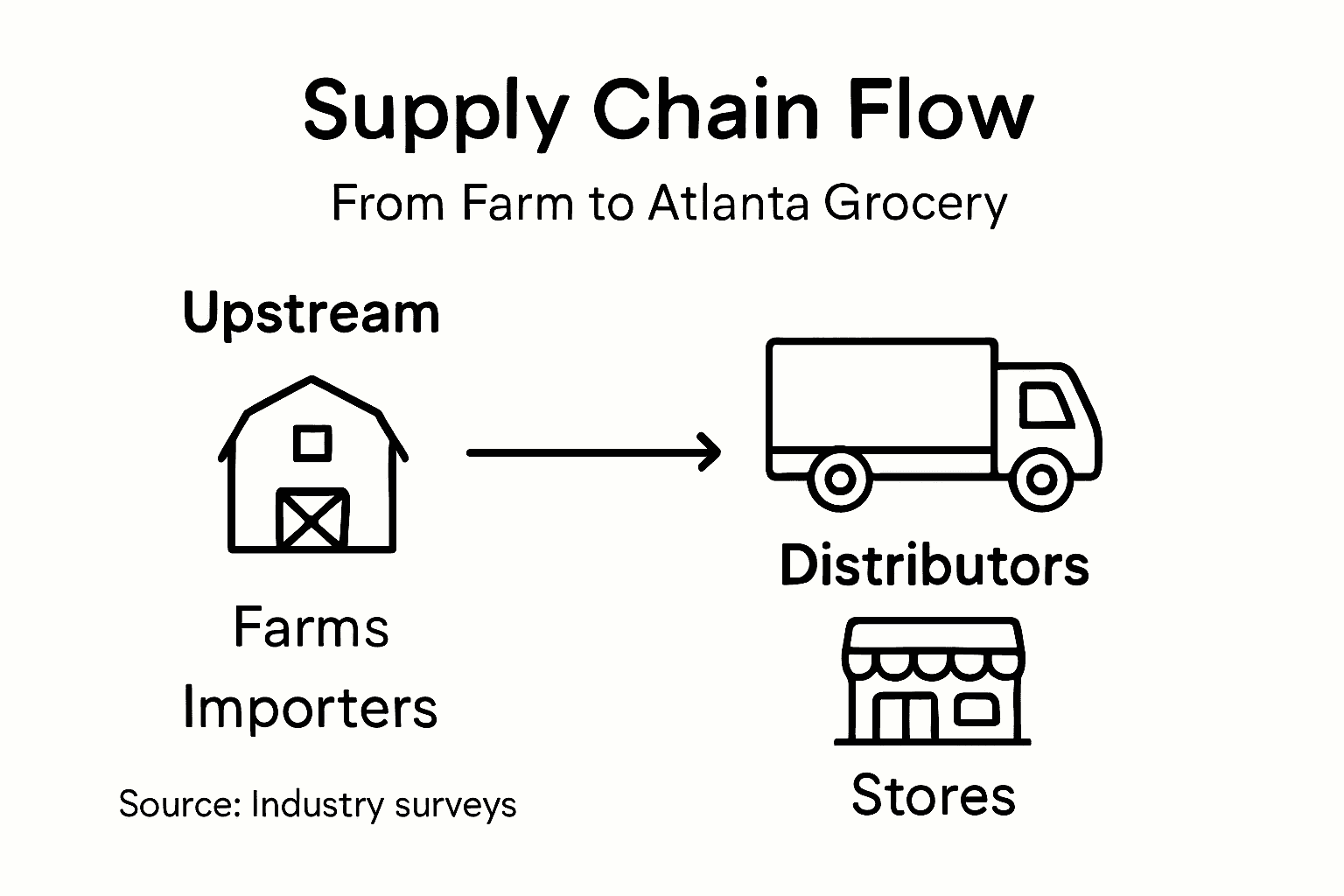
Grocery supply chains represent complex networks connecting food producers, distributors, and retailers to deliver products efficiently from farm to store shelf. Understanding these intricate systems requires examining how multiple interconnected entities collaborate to meet consumer demands.
At its core, a grocery supply chain involves several critical stages: production, storage, and distribution processes. These stages require precise coordination and management to ensure food reaches consumers safely and promptly. Caribbean grocery stores in Atlanta must navigate unique challenges, including maintaining product freshness, managing inventory diversity, and adapting to regional market dynamics.
Key misconceptions about grocery supply chains often revolve around simplistic assumptions about product movement. In reality, supply chains are sophisticated systems involving multiple decision points:
- Procurement of diverse international and local products
- Temperature-controlled transportation for perishable goods
- Inventory management across different product categories
- Risk mitigation strategies for potential supply disruptions
- Complex logistics coordination between multiple vendors
Supply chain resilience has become increasingly critical, especially after recent global disruptions. Digital technologies and sustainability frameworks now play pivotal roles in helping grocery stores anticipate and respond to market changes.
Pro tip: Develop strong relationships with multiple suppliers to create flexibility and reduce potential inventory risks.
Types of Grocery Supply Chains for Diverse Products
Grocery supply chains are not one-size-fits-all systems but rather complex networks tailored to specific product requirements and market dynamics. For Caribbean grocery stores in Atlanta, understanding the nuanced differences between supply chain models becomes crucial for maintaining product quality and meeting customer expectations.
Three primary types of supply chains dominate the grocery landscape, each designed to address unique product characteristics and distribution challenges:
-
Direct Store Delivery (DSD) Supply Chain
- Manufacturers deliver products directly to retail stores
- Ideal for perishable items like fresh produce and dairy
- Reduces warehouse handling and transportation times
-
Centralized Distribution Supply Chain
- Products flow through central warehouses before reaching stores
- More cost-effective for non-perishable and bulk items
- Allows for consolidated inventory management
-
Hybrid Supply Chain Model
- Combines elements of direct and centralized delivery
- Flexible approach for stores with diverse product ranges
- Enables customized handling for different product categories
Specialized supply chains become particularly important when dealing with international and culturally specific products. Caribbean grocery stores require sophisticated inventory management strategies that account for unique refrigeration needs, import regulations, and seasonal availability of specialized ingredients.
Successful supply chain management requires adaptability and a deep understanding of product-specific distribution requirements.
Factors influencing supply chain selection include product shelf life, transportation costs, storage requirements, and market demand. For Atlanta’s Caribbean grocery stores, this means developing intricate networks that can handle everything from tropical fruits to specialized spices and prepared foods.
Here’s a quick comparison of grocery supply chain models and their business impact for Caribbean stores:
| Model | Best For | Key Advantage | Main Limitation |
|---|---|---|---|
| Direct Store Delivery (DSD) | Perishable products | Maximizes freshness | Higher delivery complexity |
| Centralized Distribution | Non-perishables, bulk items | Lowers transportation costs | Longer delivery lead time |
| Hybrid Model | Diverse product ranges | Customizes supply approach | Coordination challenges |
Pro tip: Regularly audit and assess your supply chain model to ensure it remains aligned with changing product demands and market conditions.
How the Supply Chain Works Step by Step
The grocery supply chain is a complex journey that transforms raw ingredients into products ready for consumers, particularly challenging for Caribbean grocery stores in Atlanta managing diverse and often perishable inventories. Systematic product flow management ensures that each stage meets critical quality and safety standards.
The supply chain typically progresses through six interconnected stages:
-
Sourcing Raw Materials
- Identifying reliable agricultural producers
- Evaluating product quality and consistency
- Establishing contracts with farmers and producers
-
Processing and Manufacturing
- Transforming raw ingredients into finished products
- Implementing quality control measures
- Packaging products for distribution
-
Warehousing and Storage
- Maintaining appropriate temperature and humidity conditions
- Organizing inventory for efficient retrieval
- Implementing tracking and management systems
-
Transportation and Distribution
- Selecting appropriate shipping methods
- Ensuring product integrity during transit
- Managing logistics and route optimization
-
Retail Preparation
- Receiving and inspecting incoming products
- Organizing store inventory
- Preparing products for customer purchase
-
Customer Purchase and Feedback
- Final stage of product consumption
- Gathering consumer insights
- Informing future supply chain improvements
Successful supply chains create seamless connections between each stage, minimizing disruptions and maintaining product quality.
For Caribbean grocery stores in Atlanta, understanding food supply chain nuances becomes critical. Each product type requires unique handling, from tropical fruits needing specific refrigeration to specialty spices demanding careful preservation.
Pro tip: Develop robust tracking systems that monitor product movement and quality across every supply chain stage.
Summary table: Steps in the grocery supply chain and associated technology solutions.
| Step | Supporting Technology |
|---|---|
| Sourcing Raw Materials | Supplier databases, e-contracting |
| Processing/Manufacturing | Quality control software |
| Warehousing/Storage | Temperature IoT sensors |
| Transportation | Route optimization apps |
| Retail Preparation | Inventory management systems |
| Customer Purchase | POS and feedback tools |
Sourcing Strategies for Caribbean and Imported Goods
Sourcing for Caribbean grocery stores in Atlanta requires a nuanced approach that balances local market demands with complex international procurement challenges. Caribbean procurement strategies have evolved to address unique regional supply constraints and market complexities.
Effective sourcing strategies for Caribbean and imported goods involve multiple critical considerations:
-
Direct International Sourcing
- Establishing direct relationships with Caribbean producers
- Negotiating bulk purchase agreements
- Minimizing intermediary costs
-
Regional Supplier Networks
- Developing partnerships across Caribbean islands
- Creating diverse product portfolio
- Ensuring consistent quality standards
-
Technology-Enabled Procurement
- Utilizing digital platforms for supplier discovery
- Implementing real-time inventory tracking
- Reducing communication and logistical barriers
Strategic sourcing isn’t just about finding products - it’s about building sustainable, reliable supply ecosystems.
Sustainable supply chain frameworks offer innovative approaches for Caribbean grocery stores. These strategies focus on reducing import dependencies while supporting local economies and maintaining high-quality product standards.
Successful sourcing requires understanding complex import regulations, managing transportation logistics, and maintaining product quality through every stage of procurement. Caribbean grocery stores must balance cost-effectiveness with cultural authenticity, ensuring their product selections meet the diverse needs of Atlanta’s multicultural communities.
Pro tip: Develop relationships with multiple suppliers in different Caribbean regions to create supply chain redundancy and minimize potential disruption risks.
Inventory Management, Costs, and Common Pitfalls
Inventory management represents a critical challenge for Caribbean grocery stores in Atlanta, where balancing product diversity, freshness, and cost becomes a complex operational art. Inventory management strategies must be carefully designed to navigate the unique demands of international and perishable product lines.
Caribbean grocery stores face several key inventory management challenges:
-
Perishability Management
- Tracking shelf life of tropical and imported products
- Implementing first-in-first-out (FIFO) rotation systems
- Monitoring temperature-sensitive inventory
-
Cost Control Strategies
- Minimizing waste through precise demand forecasting
- Negotiating bulk purchase discounts
- Balancing inventory levels with storage costs
-
Technology-Driven Solutions
- Using real-time inventory tracking systems
- Implementing predictive analytics
- Automating reorder processes
Effective inventory management is about finding the delicate balance between having enough stock and avoiding excess waste.
Grocery inventory workflows highlight critical pitfalls that can significantly impact a store’s profitability. Common mistakes include overestimating demand, inadequate storage conditions, and poor supplier communication.
Successful inventory management requires a proactive approach that combines technological solutions with deep understanding of product characteristics. Caribbean grocery stores must develop flexible strategies that account for seasonal variations, cultural preferences, and rapidly changing consumer trends in Atlanta’s diverse marketplace.
Pro tip: Invest in digital inventory management systems that provide real-time tracking and predictive analytics to minimize waste and optimize stock levels.
Strengthen Your Grocery Supply Chain with TOJ Express
Managing the complexities of grocery supply chains can be challenging, especially for stores offering diverse American and Caribbean products. This article highlights key pain points such as inventory management, maintaining product freshness, and sourcing specialized goods. TOJ Express understands these challenges and offers a tailored selection that supports your store’s ability to meet customer demands with efficiency and reliability.
Experience the advantage of partnering with a convenience store that truly knows the value of product diversity and supply chain resilience. Whether you need tropical fruits requiring precise handling or specialty spices for authentic Caribbean flavors, TOJ Express provides the smart solution to help you stay ahead. Discover how our carefully chosen inventory complements your business needs and reduces common supply disruptions.
Start elevating your grocery store’s success today by exploring our full range of offerings at TOJ Express. Ready to optimize your supply chain for freshness, variety, and cost-effectiveness? Visit TOJ Express now and see the difference reliable sourcing makes.
Experience our collection
Take the first step toward a smarter grocery supply chain and customer satisfaction with TOJ Express.
Frequently Asked Questions
What are the key stages in a grocery supply chain?
The key stages in a grocery supply chain include sourcing raw materials, processing and manufacturing, warehousing and storage, transportation and distribution, retail preparation, and customer purchase and feedback.
How can grocery stores manage perishable inventory effectively?
Grocery stores can manage perishable inventory effectively by tracking shelf life, implementing first-in-first-out (FIFO) systems, and monitoring storage conditions to maintain the quality and freshness of products.
What are the different models of grocery supply chains, and how do they differ?
The primary models of grocery supply chains include Direct Store Delivery (DSD), which is ideal for perishables; Centralized Distribution, which is cost-effective for non-perishables; and Hybrid models, which combine elements of both to accommodate diverse product ranges.
What strategies can enhance sourcing for imported grocery goods?
Strategies to enhance sourcing for imported grocery goods include establishing direct relationships with producers, developing regional supplier networks, and leveraging technology for real-time inventory tracking and supplier discovery.
Recommended
- Role of Grocery Stores in Atlanta’s Diverse Wellness – TOJ EXPRESS
- Why Buy Local Snacks: Supporting Atlanta Health – TOJ EXPRESS
- How to Shop Caribbean Groceries Like a Local in Atlanta – TOJ EXPRESS
- Top 7 Tojostore.com Alternatives in 2026 for Smart Consumers – TOJ EXPRESS
- How to Start a Snack Business: Your Step-by-Step Guide – Spaceman
- 7 Ways Local Community Partnerships Boost HoreCa Success – The Ocean Straw