

Type 3–4 Hair: Use Jamaican Black Castor Oil Weekly, Plus Buying Tips
TOJEXPRESS.COM-Antonio HenryJamaican black castor oil works best as a weekly pre-wash scalp treatment and deep conditioner, especially for thick, coily, or dry hair, and as a targeted moisturizer for rough skin, cuticles, and eyebrows. It has traditional uses beyond that, but internal or systemic use should only happen under a doctor’s guidance. Always patch-test first, dilute for fine or sensitive skin, and keep it away from your eyes.
TL;DR:
- Jamaican black castor oil is best used weekly as a pre-wash scalp treatment, especially for thick, dry, and coily hair types, with better results from consistency.
- Its thick viscosity and occlusive properties help reduce breakage but do not actively promote faster hair growth.
- Topical use is effective for skin, brows, and nails, but internal or systemic use should only be under medical supervision.
- Authentic JBCO should be dark, smoky smelling, with castor oil as the sole ingredient, and stored in a cool, dark place for up to two years.
- There is limited clinical evidence for internal or external health claims; proven benefits primarily relate to conditioning, moisture retention, and reducing breakage.
Table of Contents
- What Is Jamaican Black Castor Oil, and How Is It Different?
- What Are the Main Uses for Jamaican Black Castor Oil?
- Does Jamaican Black Castor Oil Actually Help Hair Grow?
- Can You Use Jamaican Black Castor Oil on Skin, Brows, and Nails?
- What Does the Research Actually Say About Castor Oil?
- How Do You Use Jamaican Black Castor Oil Correctly?
- Is Jamaican Black Castor Oil Safe? Side Effects to Know
- Why Caribbean Retail Experience Shapes This Guide
- Our Take: Skip the Hype, Focus on Consistency
- Where to Find Authentic Jamaican Black Castor Oil in Atlanta
- Sources
What Is Jamaican Black Castor Oil, and How Is It Different?
Jamaican black castor oil (JBCO) starts the same way regular castor oil does, pressed from castor beans, but the process diverges fast. Producers roast the beans first, then boil and press them to extract the oil. That roasting step is what gives JBCO its signature dark color, smoky smell, and slightly ashy undertone, all traits you won’t find in the pale, nearly odorless cold-pressed castor oil sold for skin care.
The chemistry matters as much as the color. Both versions are loaded with ricinoleic acid, which makes up the majority of the fatty acids in castor oil and gives it documented anti-inflammatory and skin-penetrating properties. That high concentration, paired with the oil’s thick, syrupy viscosity, is why JBCO clings to strands and scalp rather than absorbing right away.
What that means in practice:
- The roasting process concentrates minerals and gives JBCO its darker, ash-tinted color.
- Higher viscosity means it sits on the hair shaft longer, which is good for sealing in moisture but bad for anyone who hates heavy products.
- The dense fatty acid profile makes it more occlusive than lighter oils like jojoba or argan, so a little goes a long way.
What Are the Main Uses for Jamaican Black Castor Oil?
Most people reach for JBCO for one of a handful of topical jobs, and it helps to separate what’s mainstream from what’s mostly folklore.
The core, well-supported uses:
- Pre-wash scalp treatment applied before shampooing to soften buildup and condition strands.
- Hot-oil treatments for extra penetration on dry or damaged hair.
- Lash and brow conditioning in tiny amounts to keep hairs from becoming brittle.
- Skin moisturizing on rough patches like elbows, heels, and knuckles.
- Cuticle and nail care to soften dry skin around the nail bed.
Beyond that, JBCO shows up in Caribbean folk remedies for things like constipation relief and sore muscles, but those uses trace back to castor oil’s laxative history rather than anything specific to the black, roasted variety. That distinction matters, because clinical evidence for castor oil’s effect on intestinal motility applies to ingestible, medical-grade formulations, not the bottle sitting in your bathroom cabinet. If you’re curious about internal use for any reason, that’s a conversation for your doctor, not a DIY project.
Does Jamaican Black Castor Oil Actually Help Hair Grow?
The honest answer is that JBCO conditions and strengthens hair reliably, but the growth claims are more nuanced than the marketing suggests. Ricinoleic acid’s occlusive quality helps trap moisture against the hair shaft and scalp, which reduces the friction that causes breakage. Less breakage often reads as “faster growth” even when the hair growing from the follicle isn’t actually growing quicker. It’s simply not falling off as fast.
Hair type plays a bigger role here than most people realize. Thick, coarse, or coily hair (type 3 and 4 textures) tends to benefit the most, since those strands are naturally drier and more prone to snapping. Fine or low-porosity hair often reacts the opposite way, ending up greasy and weighed down instead of nourished.
Here’s a realistic way to work JBCO into a routine:
- Section dry or damp hair and part it into four to six sections.
- Apply oil directly to the scalp using your fingertips, focusing on dry or thinning areas.
- Massage for two to three minutes to boost circulation and work the oil in.
- Cover with a shower cap and leave it on anywhere from one hour to overnight for type 4 hair.
- Shampoo thoroughly, since JBCO is thick enough to need a real cleanse, not a quick rinse.
Do this once a week for type 3 to 4 textures. Twice a month is usually plenty for looser curls or wavy hair.
Pro Tip: If your scalp feels itchy or your hair looks duller after a few weeks, that’s buildup talking, not a sign to apply more. Skip a week and clarify with a sulfate shampoo before going back to your routine.
Watch for softer, more manageable strands and fewer split ends over four to six weeks. If you notice increased oiliness, small bumps along the hairline, or scalp irritation, that’s your cue to dial back frequency or switch to a diluted version.
Can You Use Jamaican Black Castor Oil on Skin, Brows, and Nails?
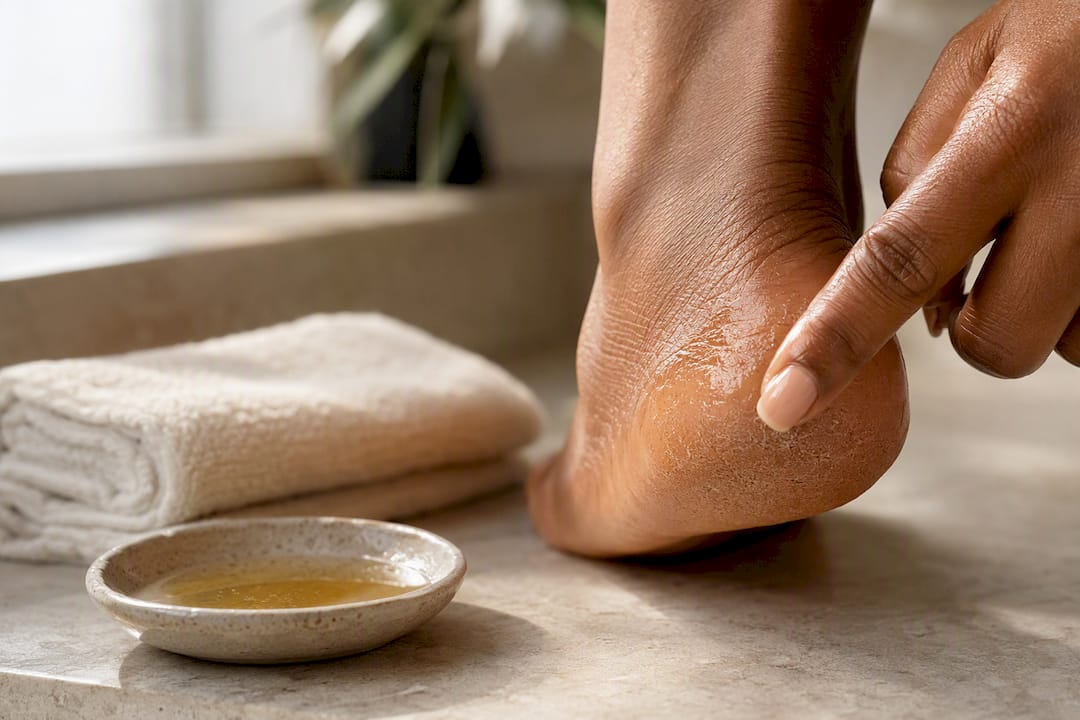
JBCO’s thick, occlusive texture makes it a solid spot treatment for skin that’s cracked, flaking, or just chronically dry, think elbows, heels, and knuckles in winter. A thin layer at night locks in whatever moisture is already there rather than adding hydration itself, since castor oil doesn’t contain water.
For scars and stretch marks, people report smoother-looking skin after weeks of consistent use, but treat that as an anecdotal outcome, not a guaranteed one. Reviews of plant oils and wound healing show promising lab-level antimicrobial activity that hasn’t fully translated into strong human clinical trials for scar reduction specifically.
Practical guidance by area:
- Brows and lashes: use an unscented, fragrance-free version and apply with a clean spoolie or cotton swab, just a drop, avoiding direct contact with your eyes.
- Nails and cuticles: massage a small amount into the cuticle nightly to soften dry skin and reduce hangnails.
- Acne-prone skin: patch-test on your inner arm for 48 hours first. Castor oil is comedogenic for some people, and thick oils can trap bacteria in already-clogged pores.
- Dry patches: apply after showering while skin is still slightly damp, so the oil seals in existing moisture instead of sitting on top of dry skin.
If breakouts appear anywhere you’ve applied it, stop and switch to a lighter, non-comedogenic oil instead.
What Does the Research Actually Say About Castor Oil?
Separating tradition from evidence matters here, because JBCO’s reputation runs well ahead of the clinical data specific to it.
The science that exists: Ricinoleic acid has documented anti-inflammatory activity in laboratory and animal studies, and castor oil has a genuinely strong clinical record as a stimulant laxative, with research confirming its effect on intestinal motility. That’s real, replicated evidence, but it applies to ingested, medical-grade castor oil under supervision, not the topical black castor oil bottle on a bathroom shelf.
The gap: No large-scale human trials have tested JBCO specifically for hair growth, scar fading, or wound healing. Lab studies on related plant oils show antimicrobial promise, but as one review of plant-based wound treatments notes, that lab activity has had mixed success translating into confirmed human clinical outcomes. Most of what’s driving JBCO’s popularity is generational, word-of-mouth Caribbean haircare practice, not peer-reviewed trials.
Don’t use topical JBCO to self-treat a systemic health issue. If you’re dealing with digestive problems, hormonal hair loss, or a skin condition that isn’t improving, see a doctor instead of layering on more oil.
How Do You Use Jamaican Black Castor Oil Correctly?
Three methods cover almost every use case, and the difference between them is mostly time and heat.
- Quick scalp massage: Warm a dime-sized amount between your palms and massage directly into the scalp for two minutes before bed. No rinsing required if you’re using a small amount on dry hair.
- Standard pre-wash treatment: Section hair, apply oil scalp-to-ends, leave on for 30 to 60 minutes under a shower cap, then shampoo twice to fully remove the residue.
- Overnight deep treatment: Apply generously, cover with a silk or satin scarf, sleep on it, and wash out in the morning with a clarifying shampoo. Best reserved for very coarse or type 4 textures that can handle the extra saturation.
Dilution depends entirely on your hair type. Coarse, type 4 hair can usually handle JBCO undiluted straight from the bottle. Thick, type 3 hair does better mixed 50/50 with a lighter carrier oil like jojoba or coconut oil. This general approach lines up with how long-established JBCO brands recommend weekly pre-wash use, especially for coily and dry textures.
Store your bottle in a cool, dark cabinet away from direct sunlight, which keeps the oil from going rancid before you finish it. A sealed bottle typically holds its quality for one to two years; once opened and exposed to air regularly, plan to use it within about a year.
Pro Tip: Check the label before buying. Authentic JBCO should look nearly black or very dark amber, smell faintly smoky rather than sweet or floral, and list castor oil as the only ingredient. If a bottle is pale gold and fragranced, you’re likely holding standard cold-pressed castor oil, not the traditional Jamaican version.
Is Jamaican Black Castor Oil Safe? Side Effects to Know
Run a patch test before your first full application: put a small amount on your inner forearm, wait 24 to 48 hours, and watch for redness, itching, or bumps. Delayed reactions can show up two days later, so don’t rush this step just because your skin looks fine after an hour.
Common issues to watch for:
- Scalp buildup or clogged follicles from overuse, usually fixed by clarifying and cutting back frequency.
- Mild irritation or breakouts on acne-prone skin, especially without dilution.
- Allergic contact dermatitis, though it’s uncommon, showing up as persistent redness or swelling that doesn’t fade within a day.
Never ingest JBCO without medical oversight. The laxative effects tied to castor oil come from specific, medically formulated products, not the topical bottle in your haircare routine, as noted in general castor oil health guidance. Keep it away from your eyes and mucous membranes entirely.
One household note worth taking seriously: the castor bean plant itself contains ricin, a toxic protein, and the ASPCA lists it as dangerous to pets. That’s a caution about the raw plant and its seeds, not the processed oil, but it’s a good reason to store any castor bean products securely if you have curious pets or small children in the house.
Why Caribbean Retail Experience Shapes This Guide
Selling Caribbean products day in and day out means seeing which JBCO bottles customers come back for and which ones sit on the shelf. That pattern alone teaches you more about authenticity than any label claim does. Tojexpress stocks Jamaican and Caribbean specialty goods for the Atlanta area, and that retail vantage point, watching what customers ask for, return for, and rave about, informs the practical guidance in this article.
Real product experience also means knowing the difference between a bottle that’s genuinely dark and smoky versus one cut with lighter oils to stretch a batch. That’s a distinction you learn from handling inventory, not from a spec sheet. Caribbean grocers who carry these products regularly tend to spot the fakes fast, because customers tell them within a week.
Our Take: Skip the Hype, Focus on Consistency
The biggest misconception about JBCO is that more oil equals faster results. It doesn’t. The people who see real improvement in hair thickness and scalp health are the ones applying it consistently, once a week, for months, not the ones drenching their scalp every other day hoping for a shortcut. Consistency beats quantity every time with this oil.
The second thing conventional advice gets wrong is treating JBCO as a cure-all. It’s a genuinely good conditioning and moisturizing oil for the right hair type, and that’s worth respecting on its own terms rather than stretching it into a fix for hair loss, digestive issues, or skin conditions it was never studied for. The evidence supports occlusion and moisture retention. It does not support miracle regrowth.
If you’re starting out, prioritize three things: buy an authentic, extra-dark, unscented product, dilute it if your hair is fine or your skin is sensitive, and give it a full six to eight weeks before deciding whether it’s working for you.
— ANTONIO
Where to Find Authentic Jamaican Black Castor Oil in Atlanta
Finding a bottle that’s actually dark, unscented, and free of filler oils is half the battle, and that’s exactly the kind of quality check Tojexpress handles before products ever hit the shelf. As a Caribbean grocer serving Atlanta and nearby communities like Stone Mountain, Decatur, and Lithonia, Tojexpress carries genuine Jamaican staples alongside American convenience items, so you’re not settling for a diluted version sold as the real thing.

When you’re shopping, look for a bottle labeled extra-dark or unscented, with castor oil as the only ingredient listed, that’s your quickest signal of authenticity. If you’re also stocking up on other Caribbean essentials, browse the health and beauty selection online or stop into the store to see what’s currently in stock. Either way, you’ll walk away with a bottle worth the shelf space.
This article is general information, not a substitute for advice from a qualified doctor. Consult a qualified healthcare professional about your own circumstances before acting on anything here.