

Soursop Tea Benefits: What the Evidence Actually Shows
TOJEXPRESS.COM-Antonio HenryOccasional soursop leaf tea is generally safe for most healthy adults, but it lacks robust human clinical evidence for medical benefits and carries a documented neurotoxicity signal that warrants real attention. MD Anderson Cancer Center advises caution and explicitly states soursop is not an evidence-based cancer treatment. The Cleveland Clinic acknowledges antioxidant activity while raising neurological safety concerns for extracts and teas. A PubMed-indexed human trial found lower systolic blood pressure in a group drinking soursop fruit juice, but that was juice, not brewed leaf tea, and the design had limitations.
Before you make soursop leaf tea a daily habit, here is what you need to know:
- Plausible benefit: Antioxidant and anti-inflammatory activity in lab and animal studies, with some traditional support for relaxation and digestive comfort.
- Evidence gap: Nearly all research used concentrated extracts or fruit pulp, not brewed leaf infusions. Human trials are scarce.
- Documented risk: Long-term high exposure to Annonaceae plants correlates with atypical parkinsonism in epidemiological data. The signal is real, even if causation is unresolved.
- Practical next step: Talk to your clinician before drinking soursop tea regularly, especially if you take blood pressure, blood sugar, or anticoagulant medications.
Key Takeaways
Soursop leaf tea has real antioxidant compounds and a long traditional history, but the human clinical evidence for medical benefits remains thin, and the neurotoxicity signal from long-term Annonaceae exposure is a documented concern that no responsible summary should minimize.
| Point | Details |
|---|---|
| Evidence is mostly preclinical | Lab and animal studies show antioxidant and anti-inflammatory activity; human trials on brewed leaf tea are scarce. |
| Neurotoxicity signal is real | Epidemiological data links long-term high Annonaceae exposure to atypical parkinsonism; occasional tea carries lower risk than extracts. |
| Not a cancer treatment | MD Anderson, Memorial Sloan Kettering, and Cleveland Clinic all state soursop lacks clinical evidence as a cancer therapy. |
| Drug interactions matter | Soursop may interact with antihypertensives, antidiabetics, and anticoagulants; consult your clinician before regular use. |
| Tojexpress for Caribbean teas | Browse whole-leaf Caribbean teas and herbal beverages at tojexpress.com, and verify labels before purchasing. |
Table of Contents
- What is soursop and which plant parts go into tea?
- How soursop leaves have been used traditionally
- Key compounds in soursop leaves and what they do
- What does the research actually say about each claimed benefit?
- What are the real safety concerns with soursop tea?
- Who should avoid soursop tea entirely?
- How to make soursop leaf tea safely
- What product forms will you find, and how do you choose?
- What should U.S. readers actually do with this information?
- A note on cultural context and informed choice
- Soursop tea and Caribbean products at Tojexpress
- Sources
What is soursop and which plant parts go into tea?
Soursop (Annona muricata) is a tropical fruit tree native to the Caribbean, Central America, and parts of West Africa and Southeast Asia. You may also see it labeled graviola, its Portuguese name, particularly on supplement packaging. The plant is entirely edible in some form, but different parts carry very different risk and benefit profiles.
The fruit pulp is what most people picture: sweet, creamy, and eaten fresh or blended into drinks. The leaves are what get brewed into tea. The seeds contain concentrated alkaloids and are generally considered toxic. Concentrated extracts and supplements are a separate category entirely, often standardized to specific compounds and delivering far higher doses than a brewed cup.
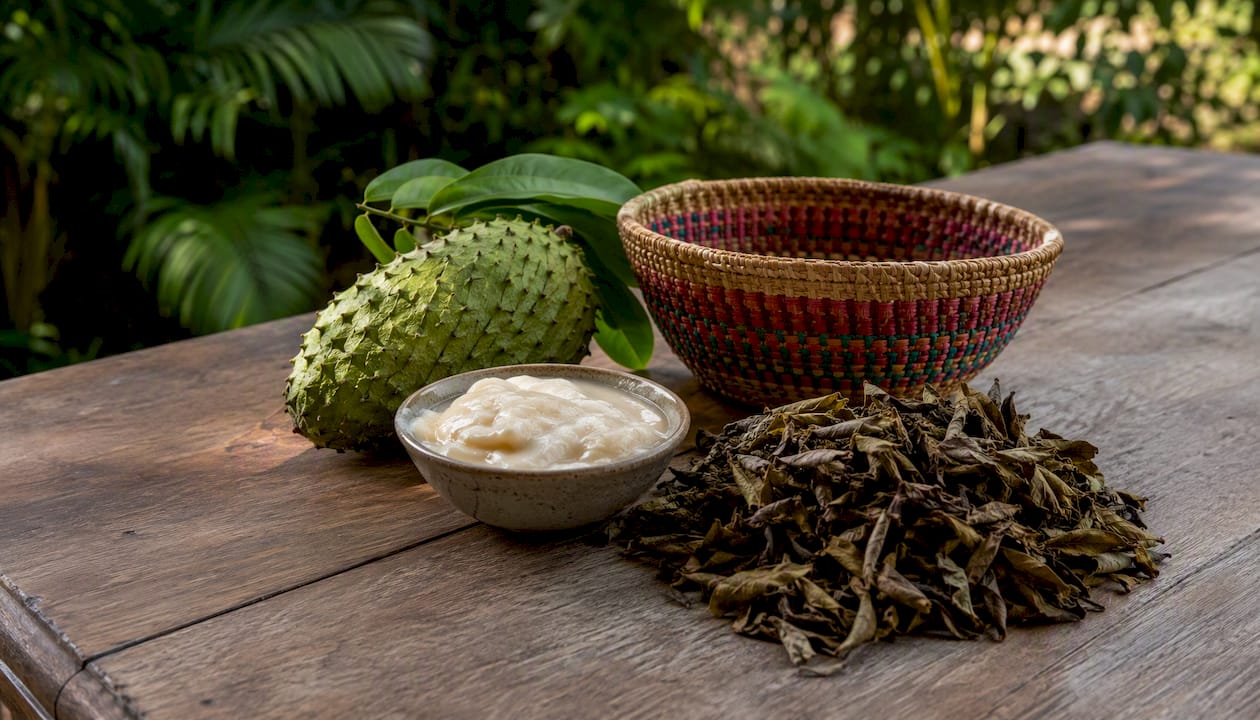
In the U.S., you can find soursop products as dried whole leaves, tea bags, bottled drinks, and capsule or liquid supplements. The distinction matters because the safety and evidence picture shifts dramatically depending on which form you use. A brewed leaf infusion and a concentrated graviola extract capsule are not interchangeable, even though they come from the same plant.
How soursop leaves have been used traditionally
Across the Caribbean, West Africa, and Southeast Asia, soursop leaves have been brewed as a folk remedy for generations. The uses vary by region but cluster around a few consistent themes:
- Relaxation and sleep: Brewed leaf tea is drunk as a calming evening beverage, often replacing caffeine-containing drinks. Northwell Health notes it is caffeine-free and has been used traditionally for this purpose.
- Respiratory support: Leaves are steeped and consumed during colds or flu-like illness in Caribbean and West African traditions.
- Anti-inflammatory and pain relief: Topical and oral use for joint discomfort and general inflammation appears across multiple traditional systems.
- Digestive support: Tea is used for stomach upset, nausea, and as a mild digestive aid in several Caribbean communities.
- Fever management: Leaf decoctions are used in some Southeast Asian folk medicine for fever reduction.
These traditions are the reason researchers started studying soursop in the first place. But traditional use is not clinical proof. A remedy that has been passed down for centuries may work, may have a placebo component, or may carry risks that only show up with long-term population data. Memorial Sloan Kettering Cancer Center summarizes the preclinical findings while consistently emphasizing that human evidence remains limited.
Key compounds in soursop leaves and what they do
Brewed leaf tea delivers phytochemicals, primarily phenolics and flavonoids, but it does not give you the fiber, vitamin C, or potassium found in the fruit pulp. The chemistry of a steeped cup is genuinely different from eating the fruit.
| Compound class | Examples | Evidence level |
|---|---|---|
| Annonaceous acetogenins | Annonacin, annonacinone | In vitro / animal (neurotoxicity signal) |
| Flavonoids | Quercetin, catechin, rutin | In vitro (antioxidant, anti-inflammatory) |
| Phenolic acids | Chlorogenic acid, caffeic acid | In vitro (antioxidant) |
| Alkaloids | Reticuline, coreximine | In vitro / animal (limited data) |
The compound that draws the most clinical attention is annonacin, an acetogenin with demonstrated neurotoxic potential in cell and animal models. Crucially, quantified measurements across preparations show that a brewed leaf infusion delivers microgram-scale amounts of annonacin, while fruit pulp and commercial nectar contain milligram quantities. That is a meaningful difference. A single occasional cup carries far lower exposure than eating the fruit regularly or taking a concentrated supplement, but the exposure is not zero.
Pro Tip: If you see a soursop product labeled “extract,” “tincture,” or “standardized,” treat it like a supplement, not a tea. The annonacin dose in those products can be orders of magnitude higher than what you get from steeping a few dried leaves.
What does the research actually say about each claimed benefit?
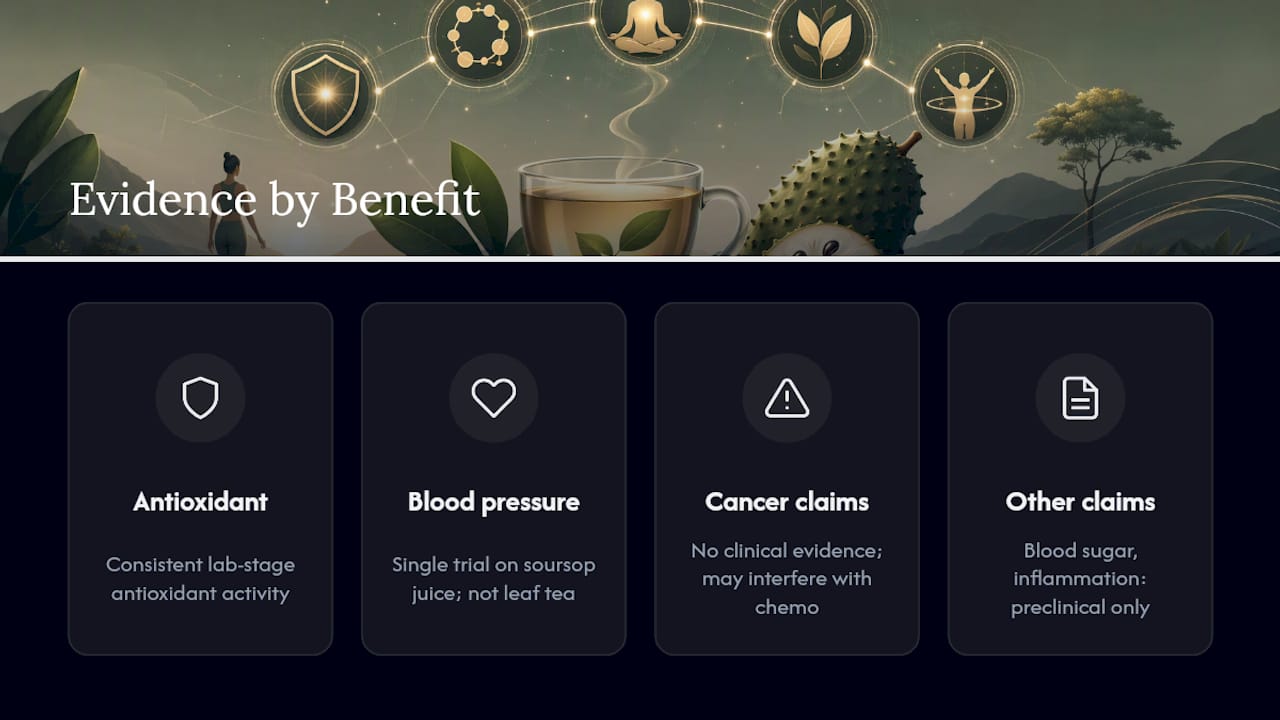
This is where the gap between popular claims and clinical evidence becomes clearest. Lab and animal studies report antioxidant, anti-inflammatory, antimicrobial, hypoglycemic, and hypotensive effects from Annona muricata extracts, but transferability to a brewed cup of leaf tea is genuinely unclear.
Blood pressure: The strongest human data comes from a randomized trial in prehypertensive adults that found lower mean systolic blood pressure in the soursop juice group. The trial tested fruit juice, not brewed leaf tea, and had design limitations. It does not establish that drinking leaf tea lowers blood pressure.
Blood sugar: Animal models show hypoglycemic effects from leaf extracts. No well-designed human trials on brewed leaf tea exist for this claim.
Inflammation: Flavonoids like quercetin and catechin have well-documented anti-inflammatory activity in lab settings. Whether the amounts in a brewed cup translate to a measurable clinical effect in humans has not been tested.
This is preclinical data only.
Sleep and relaxation: Caffeine-free and traditionally used as a calming drink. No controlled human trials support a specific sedative mechanism, but the absence of caffeine alone makes it a reasonable evening beverage choice.
Anticancer claims: This is where the evidence gap is most consequential. This is not the same as treating cancer in a human body. MD Anderson states plainly that soursop lacks clinical evidence as a cancer treatment and warns it may interfere with chemotherapy. The same position is held by Memorial Sloan Kettering.
Research bottom line: Antioxidant activity in lab settings is the most consistent finding. Every other claimed benefit rests on preclinical data or a single limited human trial that studied a different preparation. As the NIH Office of Dietary Supplements context makes clear, antioxidant activity measured in a test tube does not automatically translate to clinical health outcomes.
What are the real safety concerns with soursop tea?
The neurotoxicity signal is the most important safety issue and the one most often glossed over in popular coverage. Epidemiological studies in Guadeloupe found a correlation between long-term high dietary exposure to Annonaceae plants and atypical parkinsonism, a Parkinson’s-like neurological condition. Memorial Sloan Kettering documents this association. Causation has not been confirmed, but the signal is strong enough that neurologists take it seriously, particularly for people with any personal or family history of movement disorders.
Beyond neurotoxicity, the documented safety concerns include:
- Drug interactions: Soursop extracts show additive hypotensive effects in animal models, raising concern about interactions with antihypertensive medications. Similar additive effects are possible with antidiabetic drugs. MD Anderson specifically flags these interactions.
- Anticoagulants: Potential interactions with blood-thinning medications have been noted, though human data is limited.
- Perioperative risk: As with many herbal preparations, stopping use before surgery is advisable due to unknown interactions with anesthesia and perioperative medications.
- Seed toxicity: Soursop seeds contain concentrated alkaloids. Never consume them or use products that include ground seeds.
- Unregulated supplements: Concentrated graviola capsules and tinctures are not regulated as drugs by the FDA. Label claims are not independently verified, and dosing is inconsistent.
Pro Tip: Watch for these neurological symptoms if you drink soursop tea regularly: unusual tremors, balance problems, or slowed movement. These can be early signs of movement-disorder issues. Stop use and consult your doctor promptly if any appear. People already taking blood pressure or diabetes medications should discuss soursop with their prescriber before starting, since even brewed tea may have an additive effect at higher intake.
Who should avoid soursop tea entirely?
Some groups face enough risk that even occasional brewed leaf tea is not advisable without explicit clinician approval:
- Pregnant or breastfeeding people: No safety data exists for this population, and the acetogenin content makes caution the only reasonable position.
- People with Parkinson’s disease or any parkinsonism: The neurotoxicity association makes this a hard contraindication. URMC and other integrative medicine resources flag this explicitly.
- People taking antihypertensive medications: Additive blood-pressure lowering is a real concern, not a theoretical one.
- People taking antidiabetic medications: Similar additive hypoglycemic risk applies.
- People on anticoagulants (warfarin, apixaban, etc.): Potential interaction risk warrants clinician review before use.
- Anyone scheduled for surgery within two weeks: Stop all herbal preparations, including soursop tea, before elective procedures.
- Children: No pediatric safety data exists.
- People currently undergoing chemotherapy or radiation: MD Anderson advises against soursop use during cancer treatment due to potential interference with therapy.
Talk to your doctor if you have any neurological history, take prescription medications for blood pressure or blood sugar, or have a family history of Parkinson’s disease. Bring the product label to the appointment.
How to make soursop leaf tea safely
A basic brewed leaf infusion is the lowest-exposure form of soursop and the preparation most consistent with traditional use. Here is a straightforward method:
- Use dried whole leaves. Start with a small amount of dried soursop leaves per cup. Do not use powdered leaf or extract products for this preparation.
- Heat water to just below boiling (around 200°F / 93°C). A full rolling boil is fine for a decoction but can degrade some flavonoids in a simple infusion.
- Steep for 10–15 minutes for a standard infusion. For a stronger decoction, simmer the leaves in water for 15–20 minutes, then strain.
- Strain thoroughly and discard the leaves. Do not consume the leaves themselves.
- Drink one cup as a single serving. Occasional use (a few times per week at most) is a more cautious approach than daily consumption.
- Do not sweeten with large amounts of sugar if blood sugar management is a concern.
Extracts, tinctures, and capsules are a different category. They are not “stronger tea.” They deliver concentrated doses of acetogenins and other compounds that far exceed what a brewed cup provides, and they should be treated as supplements with all the corresponding caution.
Pro Tip: When buying dried soursop leaves, look for a clear country of origin on the label, whole dried leaves rather than powder, and a lot or batch number. Avoid products with vague “proprietary blend” language that obscures what is actually in the package. Caribbean specialty retailers who source directly from known suppliers are generally a safer bet than anonymous online listings.
What product forms will you find, and how do you choose?
Soursop products in the U.S. fall into a few distinct categories, and the exposure level rises significantly as you move down this list:
Brewed leaf infusion (lowest exposure): Dried whole leaves steeped in hot water. This is the traditional preparation and the form with the most favorable safety profile for occasional use.
Fresh or frozen fruit pulp: Higher annonacin content than brewed tea. Eaten as food in reasonable amounts, the fruit is generally considered safe, but regular large quantities raise cumulative exposure concerns.
Bottled soursop drinks and nectars: These vary widely. Some are dilute juice blends; others are concentrated. Check the ingredient list for “soursop extract” or “graviola extract,” which signal higher-exposure products.
Concentrated extracts, capsules, and tinctures: The highest-exposure forms. These are marketed as supplements and are not regulated for efficacy or safety by the FDA. Avoid daily use without clinician guidance.
For quality signals, look for: a clear ingredient list with no mystery “blends,” a named country of origin, whole dried leaf rather than powder or extract, and third-party testing certification when available. Frequency matters as much as form. An occasional cup carries far lower cumulative exposure than daily use over months, which is where the epidemiological neurotoxicity data becomes relevant.
If you want a well-studied, low-risk herbal alternative for digestive comfort or evening relaxation, Caribbean Dreams Peppermint Tea or Caribbean Dreams Instant Ginger Tea are options with a cleaner safety record. For a broader look at how specialty herbal beverages fit into a wellness routine, the specialty beverages guide at Tojexpress covers the category well.
What should U.S. readers actually do with this information?
The evidence picture for soursop leaf tea is genuinely mixed, and that deserves a straight answer rather than a hedge.
- What is plausible: Antioxidant activity from flavonoids and phenolic acids in brewed leaf tea is biologically real. Drinking it occasionally as a caffeine-free, relaxing beverage is a reasonable choice for most healthy adults.
- What is not proven: Soursop tea has not been shown in human clinical trials to treat any disease, lower blood pressure, control blood sugar, or fight cancer. The lab findings are interesting; they are not treatment evidence.
- The safety concern you cannot ignore: The neurotoxicity association with long-term Annonaceae exposure is documented in epidemiological data. It does not mean one cup will harm you. It does mean daily use over months or years, especially with concentrated products, carries a risk that has not been adequately studied.
- Practical guidance: Occasional brewed leaf tea, made from whole dried leaves, is the safest form. Avoid concentrated extracts. Stop use if neurological symptoms appear. Consult your clinician if you take prescription medications or have any movement disorder history.
Soursop is not an evidence-based cancer treatment. MD Anderson, Memorial Sloan Kettering, and Cleveland Clinic all hold this position clearly. Using it instead of or alongside cancer therapy without your oncologist’s knowledge is a documented safety risk.
A note on cultural context and informed choice
Caribbean communities have been drinking soursop leaf tea for generations, and that tradition carries real meaning. At Tojexpress, we sell Caribbean products because we believe in the cultural and culinary value of the Caribbean pantry, soursop included. That context matters when you are deciding whether to try something your grandmother made or a tea you grew up with.
What we would not want is for anyone to drink soursop tea believing it treats a serious illness, or to skip a clinician conversation because the tea feels natural and familiar. Occasional enjoyment of a brewed cup is a reasonable choice. Treating it as medicine without professional guidance is a different decision entirely, and one the evidence does not support.
Soursop tea and Caribbean products at Tojexpress
Tojexpress carries a curated selection of Caribbean teas and herbal beverages, including products sourced from the Caribbean region for customers in Atlanta and surrounding communities including Stone Mountain, Decatur, Lithonia, and Conyers. If you are looking for whole-leaf soursop tea or other Caribbean herbal drinks, you can browse the full range at Tojexpress. When you shop, check the label for whole dried leaves rather than powder or extract, and look for a clear country of origin. For a broader selection of loose-leaf and herbal teas, Qahwat Al’ard’s tea collection is worth a look as well.
Before making soursop leaf tea a regular part of your routine, especially if you take prescription medications, talk to your clinician first.

Sources
The claims in this article draw on clinician-reviewed and peer-reviewed sources. For clinical decisions, consult these pages directly rather than relying on any single article:
- Soursop: Does this tropical fruit have health benefits?
- 6 Health Benefits of Soursop
- PubMed entry (representative human trial)
- PubMed entry (annonacin quantification / exposure context)
- Embrace Soursop’s Benefits In Tea Form | The Well by Northwell
This article provides general health information only and is not a substitute for professional medical advice. Verify current guidance with a qualified clinician before making changes to your diet or supplement routine.