
20 Examples of American Cereals Everyone Should Know
TOJEXPRESS.COM-Antonio HenryCheerios, Cinnamon Toast Crunch, Froot Loops, Frosted Flakes, Lucky Charms, Cocoa Puffs, Rice Krispies, and Fruity Pebbles make up the core of any list of famous US cereal brands, the boxes you’d find in nearly every American pantry from the 1970s onward. If you only remember one name from this list, make it Cinnamon Toast Crunch. A recent consumer survey found 43% of respondents had eaten it in the prior 12 months, more than any other cereal tracked, and its mix of cinnamon crunch and mild sweetness works for kids, adults, and anyone snacking straight from the box.
That’s the short answer. The rest of this guide breaks down a full ranked list of 20 popular American cereals, groups them by category so you can shop by goal (low sugar, whole grain, hot cereal, novelty), explains what the big manufacturers actually specialize in, and walks through how to read a nutrition label so packaging claims don’t fool you. You’ll also find a handful of ways to eat cereal beyond the bowl, and where to actually find these brands if your local shelf runs thin. Tojexpress stocks a rotating lineup of American breakfast staples for shoppers around Atlanta, Stone Mountain, Decatur, and Lithonia who want the real thing instead of a regional substitute.
Key Takeaways
Cinnamon Toast Crunch and Cheerios lead American cereal consumption, and choosing between sweet, plain, or fiber-forward options comes down to reading sugar and fiber per serving rather than trusting the front of the box.
| Point | Details |
|---|---|
| Most consumed cereal | Cinnamon Toast Crunch reaches 43% consumption, ahead of Cheerios at 41% and Fruity Pebbles at 34%. |
| Four brands dominate | General Mills, Kellogg’s, Post, and Quaker account for most of the $8.5 billion cereal market. |
| Check fiber, not just sugar | Frosted Mini-Wheats and Raisin Bran pair moderate sugar with 5 grams or more of fiber per serving. |
| Whole grain claims need verification | Look for whole grain listed as the first ingredient, not just a front-of-box claim. |
| Buy from a source that stocks real brands | Tojexpress carries American breakfast staples for shoppers around Atlanta seeking authentic name-brand cereals. |
Table of Contents
- Examples of American Cereals: The Top 20 Ranked
- American Cereal List by Category
- Who Makes These Cereals: General Mills, Kellogg’s, Post, and Quaker
- How to Read a Cereal Label (So Packaging Claims Don’t Fool You)
- A Quick Checklist for Choosing a Cereal
- What a 2025 Consumer Survey Reveals About Cereal Habits
- Creative Ways to Use Cereal Beyond a Bowl of Milk
- Why This List Leans on Popularity and Practicality
- Find These Cereals (and More American Breakfast Staples) at Tojexpress
- Frequently Asked Questions
- Sources
Examples of American Cereals: The Top 20 Ranked
This ranking leans on flavor, cultural staying power, and how often each cereal actually shows up in kitchens, not just marketing buzz. Sources like the Daily Meal’s taste-based ranking and Reviewed’s list of 50 memorable cereals weigh similar factors: taste, texture, ingredient quality, and nostalgia. Here’s how the field shakes out.
1. Cinnamon Toast Crunch (General Mills). Cinnamon sugar baked onto crunchy squares, this one edges out everything else in raw popularity, with that 43% consumption rate leading the pack. Sugar content runs around 9 grams per serving. Best served with cold milk, though it holds up surprisingly well dry as a snack.
2. Best for anyone who wants a cereal that won’t spike a sugar crash by 10 a.m.
3. Frosted Flakes (Kellogg’s). Corn flakes coated in a sugar glaze, fronted by Tony the Tiger since 1952. Sugar sits around 10 grams per serving, so it’s a nostalgia and taste pick more than a health one. Great with milk, better as an ice cream topping.
4. Froot Loops (Kellogg’s). Fruit-colored rings with a flavor that’s more “generic sweet” than any specific fruit, which is part of the charm. Around 11 grams of sugar per serving puts it firmly in the kid-friendly, treat-yourself category. Milk turns a rainbow color, which is either delightful or slightly alarming depending on your age.
5. Lucky Charms (General Mills). Oat pieces plus marshmallow bits (“magically delicious” since 1964), with roughly 10 grams of sugar per serving. The marshmallows are the whole point here, so don’t expect a fiber play. Best eaten fast before the marshmallows go soggy.
6. Cocoa Puffs (General Mills). Chocolate-flavored corn puffs that turn milk into chocolate milk, a feature kids treat as a bonus. Sugar runs close to 11 grams per serving. Works well as a mix-in for trail mix if you want to cut a plain cereal’s blandness.
7. Rice Krispies (Kellogg’s). The “snap, crackle, pop” cereal, made from crisped rice with a lighter sugar profile than most kid cereals, around 4 grams per serving. Best known now as the base for Rice Krispies Treats, which arguably outsells the cereal-in-a-bowl use case.
8. Fruity Pebbles (Post). A Flintstones tie-in since 1971 that’s still one of the most consumed cereals in the country, sitting at 34% consumption in the recent survey. Crunchy rice pebbles with fruity coating, around 9 grams of sugar per serving. Best for anyone who wants max crunch retention in milk.
9. Corn Flakes (Kellogg’s). The cereal that started the entire American cereal industry, created by the Kellogg brothers in Battle Creek, Michigan in the 1890s. Plain, low sugar (about 3 grams per serving), whole grain isn’t the primary ingredient but the simplicity is the appeal. Best as a coating for baked chicken or a binder in meatloaf, seriously.
10. Frosted Mini-Wheats (Kellogg’s). Shredded wheat biscuits with a frosted top, one of the few cereals that pairs real fiber (around 5 grams per serving) with enough sweetness that kids don’t reject it outright. Best for anyone who wants a whole-grain cereal that doesn’t taste like cardboard.
11. Trix (General Mills). Fruit-shaped corn puffs with a candy-forward flavor and around 10 grams of sugar per serving. The “Silly Rabbit, Trix are for kids” tagline has outlived several rebrand attempts. Best for pure nostalgia rather than nutrition.
12. Reese’s Puffs (General Mills). Peanut butter and chocolate flavored puffs licensing the Reese’s name, with roughly 9 grams of sugar per serving. This is the cereal aisle’s answer to candy for breakfast, and it doesn’t pretend otherwise. Best eaten as a snack straight from the box.
13. Special K (Kellogg’s). Lightly sweetened flakes marketed for decades around weight management, with sugar around 4 grams per serving and added vitamins and minerals. Best for anyone prioritizing a lighter breakfast without going full plain-oat territory.
14. Kix (General Mills). Puffed corn cereal with almost no added sugar, around 3 grams per serving, marketed with the old “kid tested, mother approved” line. Best for toddlers and anyone avoiding sugary breakfasts without sacrificing crunch.
15. Honey Bunches of Oats (Post). A flake-and-granola-cluster combo with actual whole oats, around 6 grams of sugar per serving and more texture variety than most cereals on this list. Best for adults who want something between “health cereal” and “treat cereal.”
16. Raisin Bran (Kellogg’s and Post both make versions). Bran flakes mixed with raisins, one of the higher-fiber options on shelves at 7 to 8 grams of fiber per serving. Best for digestive health and for anyone who actually likes raisins in their cereal.
17. Apple Jacks (Kellogg’s). Cinnamon and apple flavored rings, despite tasting closer to cinnamon candy than actual apples, with around 12 grams of sugar per serving. Best for kids who’ve already worked through Froot Loops and Trix.
18. Cap’n Crunch (Quaker). Corn and oat cereal known for its distinctively sharp crunch (and its reputation for scraping the roof of your mouth), around 12 grams of sugar per serving. Best served fast, since it turns to mush in milk quicker than most.
19. Wheaties (General Mills). The “Breakfast of Champions” since 1924, plain wheat flakes with minimal sugar (around 4 grams per serving) and a marketing history built entirely around athlete endorsements. Best for anyone who wants a cereal with actual sports history behind it.
20. Grape-Nuts (Post). Dense, crunchy wheat and barley nuggets that contain neither grapes nor nuts, one of the oldest cereals in continuous production (since 1897). High fiber, around 7 grams per serving, and low sugar. Best soaked in milk for a few minutes before eating, or mixed into yogurt.
American Cereal List by Category
Grouping cereals by what they’re actually good for makes shopping faster, especially if you’re stocking a house with different ages and different goals under one roof.
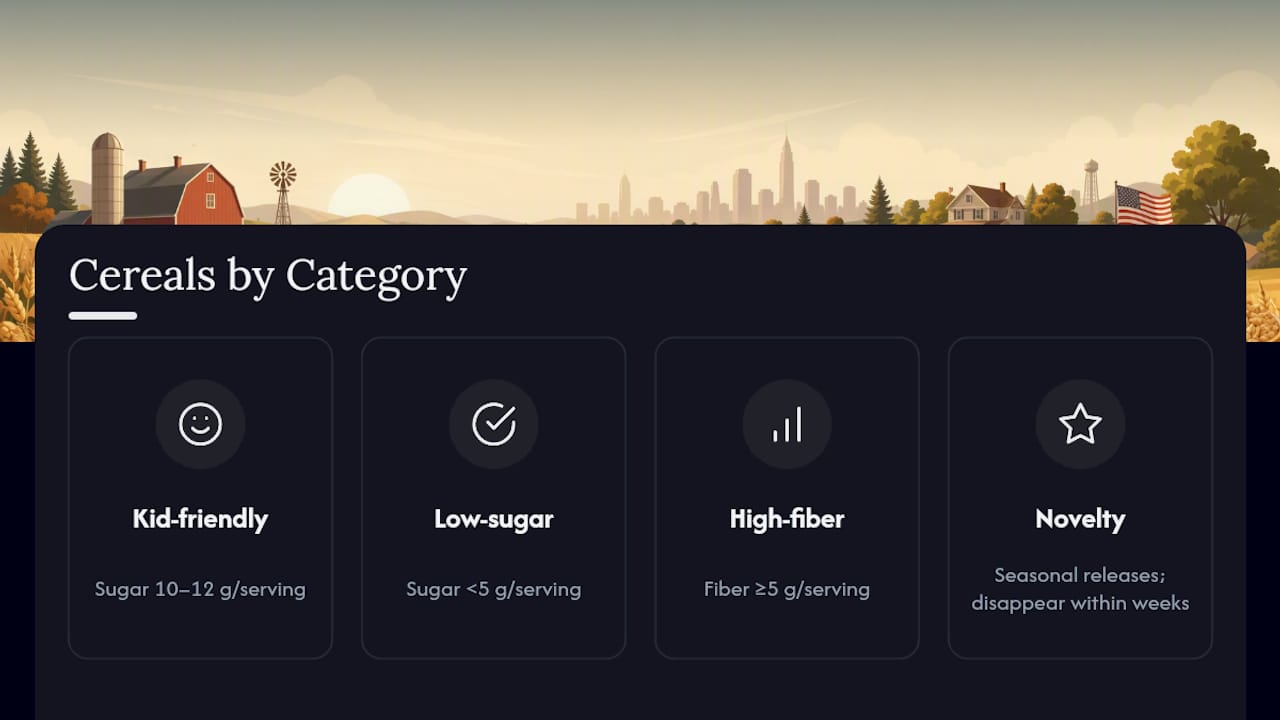
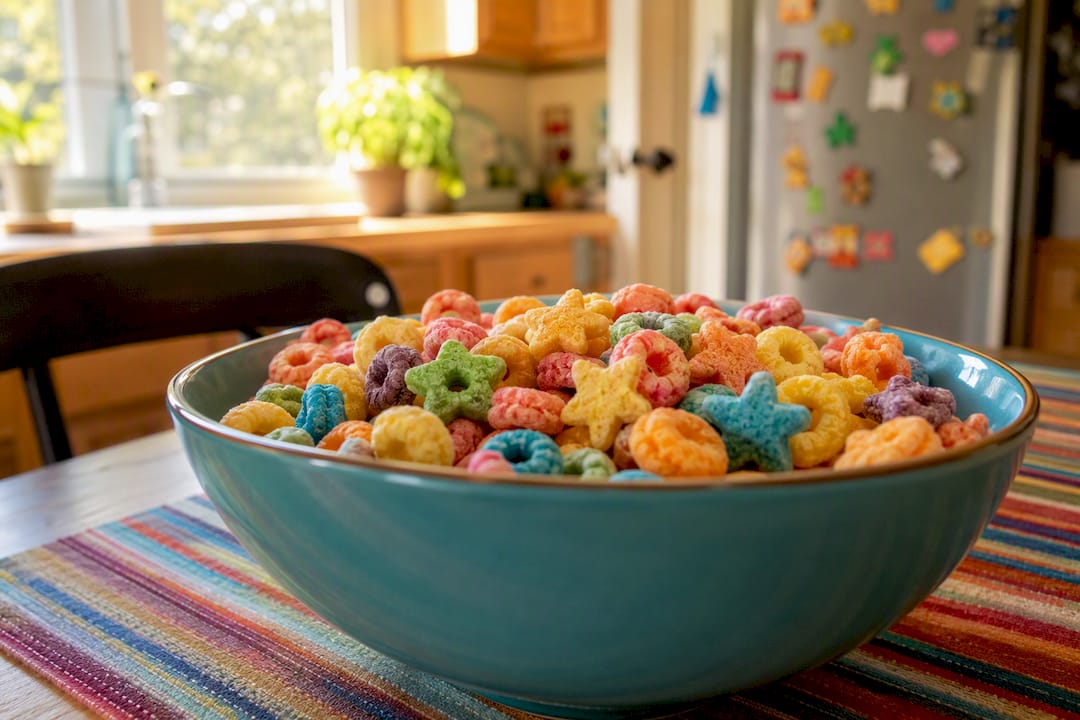
Kid-friendly and sugary: Froot Loops, Lucky Charms, Trix, Cocoa Puffs, and Apple Jacks lead this group. Bright colors, cartoon mascots, and sugar counts in the 10 to 12 gram range per serving are the common thread. These are treat cereals, not everyday staples, and most parents know it.
Low-sugar and whole-grain: Cheerios, Kix, Special K, and Wheaties sit here, all under 5 grams of sugar per serving with a grain-forward ingredient list. These are the cereals that show up in weekday rotations because nobody has to negotiate a sugar crash an hour later.
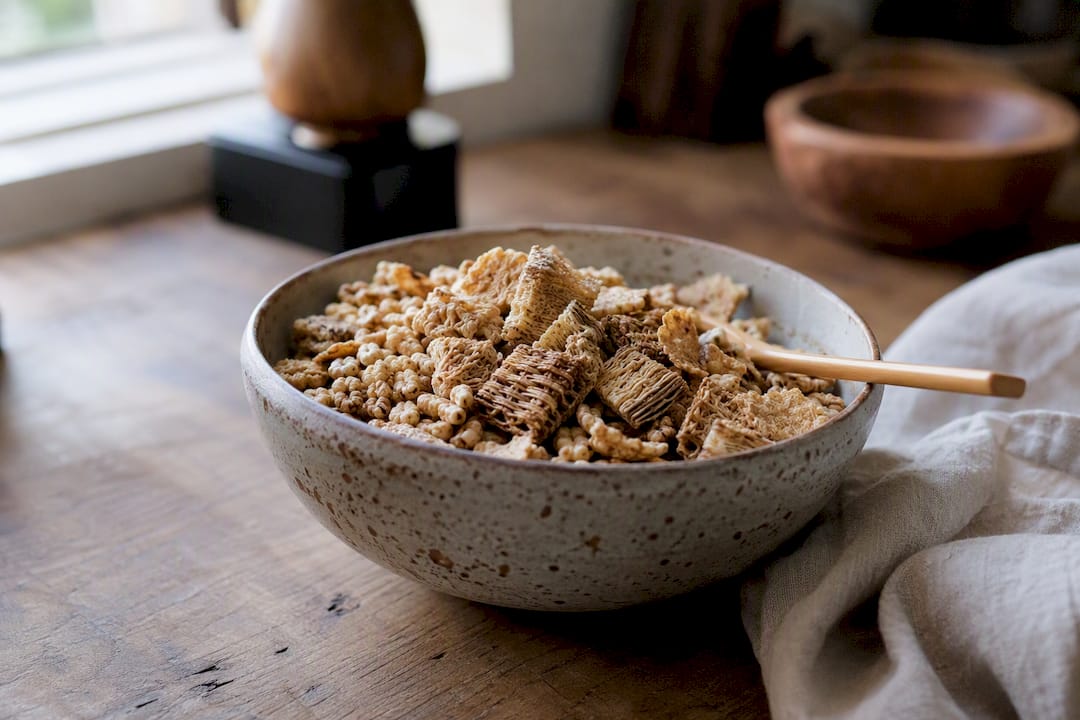
High-fiber: Frosted Mini-Wheats, Raisin Bran, and Grape-Nuts pack the most fiber per bowl, often 5 grams or more, thanks to bran and shredded wheat bases. These cereals fit best for anyone managing digestion or just trying to stay full past 10 a.m.
Hot cereals: Oatmeal (Quaker Oats being the dominant name here) and cream of wheat style products round out the category. These aren’t packaged the same way as cold cereal, but they belong on any list of American breakfast cereals since they outsell several cold options combined in colder months.
Novelty and limited-edition: Seasonal releases like pumpkin spice Cheerios, Halloween-themed Froot Loops with candy corn colors, and holiday Rice Krispies show up every year and disappear within weeks. Reese’s Puffs also fits here as a candy-crossover product that blurs the line between cereal and dessert.
Pro Tip: If you’re trying to cut sugar without losing your kids’ cooperation, mix a sugary cereal half-and-half with a plain one like Cheerios or Kix in the same bowl. The overall sweetness stays high enough to satisfy, but the sugar per bowl drops significantly.
A few cereals cross categories in useful ways. Frosted Mini-Wheats works as both a kid-friendly cereal and a whole-grain option because the sweet frosting doesn’t cancel out the fiber underneath. Honey Bunches of Oats does something similar, splitting the difference between a treat and a health food.
Who Makes These Cereals: General Mills, Kellogg’s, Post, and Quaker
Four companies dominate the American cereal aisle, and ready-to-eat cereal sales total roughly $8.5 billion a year, with those four brands accounting for most of it.
- General Mills owns Cheerios, Cinnamon Toast Crunch, Lucky Charms, Cocoa Puffs, Trix, Kix, Reese’s Puffs, and Wheaties, giving it the widest spread across sweet, plain, and licensed products.
- Kellogg’s produces Frosted Flakes, Froot Loops, Rice Krispies, Corn Flakes, Frosted Mini-Wheats, Special K, Apple Jacks, and one version of Raisin Bran, with Corn Flakes standing as the cereal that launched the entire industry out of Battle Creek, Michigan in the 1890s.
- Post makes Fruity Pebbles, Honey Bunches of Oats, Grape-Nuts, and its own Raisin Bran line, leaning slightly more into fiber-forward and licensed-character products.
- Quaker (PepsiCo) is best known for Cap’n Crunch and its dominant position in hot cereal through Quaker Oats.
- Malt-O-Meal produces budget store-brand equivalents of most major cereals, sold in bags instead of boxes, and shows up widely as a lower-cost alternative on grocery shelves.
The full historical catalog of American cereal brands documents just how many of these products trace back 50, 70, even 130 years, which explains why so many feel less like snack food and more like inherited family habit.
How to Read a Cereal Label (So Packaging Claims Don’t Fool You)
Cereal boxes are built to sell you on health claims that don’t always hold up once you flip to the nutrition panel. Here’s what to actually check, in order:
- Sugar per serving. Anything under 5 grams is low, 5 to 9 grams is moderate, and 10 grams or more puts a cereal in dessert territory.
- Fiber per serving. Look for 3 grams or more; Frosted Mini-Wheats, Raisin Bran, and Grape-Nuts all clear this bar comfortably.
- Whole grain position. Check whether “whole grain” or “whole wheat” appears as the first ingredient, not buried third or fourth behind sugar and corn syrup.
- Added vitamins and minerals. Most cereals are fortified with iron, folic acid, and B vitamins, which matters more for kids and less for adults eating a varied diet.
- Serving size versus what you’d actually pour. Listed servings often run smaller than a real bowl, sometimes half of what people actually eat, which quietly doubles the sugar and calorie math.
Compare two boxes side by side and the gap gets obvious fast. A serving of Froot Loops runs about 11 grams of sugar and 1 gram of fiber. A serving of Frosted Mini-Wheats runs about 10 grams of sugar but 5 grams of fiber, meaning you get roughly the same sweetness with five times the fiber. That’s the trade worth knowing before you shop.
Pro Tip: *If a cereal box advertises “made with whole grain” in big letters on the front, flip it over.
The 2025 survey data on cereal consumption makes an interesting point here: the most popular cereals in America (Cinnamon Toast Crunch, Cheerios, Fruity Pebbles) span the full range from sugary to nearly sugar-free. Popularity and nutrition profile don’t track together, which means the “best” cereal really depends on what you’re optimizing for that morning. For a deeper look at building a breakfast that keeps you full longer, our guide to choosing breakfast foods for sustained energy covers pairing cereal with protein and fat to avoid a mid-morning crash.
A Quick Checklist for Choosing a Cereal
- Decide your priority first. Are you shopping for taste, health, or straight-up nostalgia? That answer eliminates half the aisle immediately.
- Check sugar and fiber together, not separately. A cereal with 8 grams of sugar and 5 grams of fiber behaves very differently in your body than one with 8 grams of sugar and 0 fiber.
- Scan the ingredient list for whole grain placement. First or second ingredient is a real signal; buried further down, it’s mostly marketing.
- Weigh price against portion. Family-size boxes cost less per ounce, but a store-brand equivalent from Malt-O-Meal often beats the name brand on price without much taste difference.
- Try before you commit to a big box. If you’re testing a new cereal, buy the smallest size available or a single-serve box first, especially with anything marketed as a limited seasonal flavor.
Watch for seasonal releases if you like novelty. Pumpkin spice and holiday-themed versions of familiar cereals show up every fall and winter, then vanish from shelves within a few weeks of the new year.
What a 2025 Consumer Survey Reveals About Cereal Habits
The numbers back up what most people already suspect: cereal is as much a nostalgia snack as it is a breakfast food. The 2025 survey found Cinnamon Toast Crunch led all cereals at 43% consumption over the prior 12 months, with Cheerios close behind at 41% and Fruity Pebbles at 34%. That’s a meaningful gap between the top sweet cereal and the top plain one, and it suggests taste wins out over health positioning for a lot of shoppers, even when they know better.
The survey measured self-reported consumption over a 12-month window, which captures habitual eaters well but doesn’t distinguish between someone who eats a bowl daily and someone who bought one box in March. Treat the percentages as a popularity signal, not a precision metric.
Cereal in America isn’t just a breakfast category, it’s a snack food eaten straight from the box, standing at the counter, at any hour of the day. That informal, convenience-driven habit is a big part of why nostalgic brands keep outperforming newer, more “optimized” health cereals year after year.
That cultural pattern explains a lot about why 50-year-old brands still top usage charts instead of newer, better-formulated competitors.
Creative Ways to Use Cereal Beyond a Bowl of Milk
Cereal boxes don’t have to end at breakfast. Here are ways to stretch a box further:
- Yogurt parfait topping, layered with fruit for crunch and texture.
- Trail mix base, mixing something like Chex or Cocoa Puffs with nuts and dried fruit.
- Cereal milk, steeping a sweet cereal like Fruity Pebbles or Froot Loops in milk, then straining it for a flavored milk base.
- Pancake or waffle batter mix-in, crushed and folded in for texture.
- Snack clusters, baked with a little honey or butter to bind crushed cereal into bars.
- Ice cream topping, especially Cinnamon Toast Crunch or Cap’n Crunch for crunch contrast.
- Cereal-crusted chicken or fish, using crushed corn flakes or Rice Krispies as a breading substitute.
- Homemade granola-style bake, combining oats-based cereals with honey and nuts, then baking until crisp.
Pro Tip: Store leftover cereal in an airtight container instead of the original bag once opened; it stays crunchy for cooking uses far longer than sitting exposed in a pantry.
Flakes and puffs handle breading and crusting best because they crush into a fine, even texture. Puffed cereals like Kix and Rice Krispies work better for cereal milk and kid snacks since they hold their shape without turning to mush right away. Sweet snack pairings deserve their own rabbit hole too. If cereal-as-candy is your thing, our breakdown of popular American candy brands covers a lot of the same flavor territory as novelty cereals.
Why This List Leans on Popularity and Practicality
Curating this list meant weighing three things: how widely recognized a cereal actually is, how versatile it is beyond the breakfast bowl, and whether it earns a spot on both a nostalgia list and a practical shopping list. That’s why Cheerios and Cinnamon Toast Crunch sit at the top instead of a more “correct” health pick. Real shopping decisions involve trade-offs between what tastes good and what fits a family’s actual habits, not just what a nutrition label says on paper.
Tojexpress focuses specifically on American and Caribbean grocery staples for shoppers who want the real brands they grew up with, not a regional substitute or a diluted store version. That focus shapes which products actually make sense to stock and recommend.
Find These Cereals (and More American Breakfast Staples) at Tojexpress
Most of the cereals on this list aren’t always easy to find at full stock in every regional grocery chain, especially name-brand boxes rather than store equivalents. Tojexpress carries a rotating selection of American breakfast staples for shoppers in Atlanta, Stone Mountain, Decatur, Lithonia, Conyers, Tucker, Snellville, and Rockdale, Georgia, alongside the Caribbean groceries the store is built around.
Stock varies by season, and some novelty or limited-edition flavors sell out fast once they land, so check current availability before planning a big shopping trip around one specific box. Both in-store pickup and online ordering are available if you’d rather browse from home first. Start by shopping the current grocery selection at Tojexpress to see what’s in stock this week.
Frequently Asked Questions
What are the top 10 cereals in America? Based on popularity and cultural staying power, the top 10 typically include Cinnamon Toast Crunch, Cheerios, Frosted Flakes, Froot Loops, Lucky Charms, Cocoa Puffs, Rice Krispies, Fruity Pebbles, Corn Flakes, and Frosted Mini-Wheats.
Which cereals are American? Nearly all of the cereals on major U.S. grocery shelves count as American cereal brands, since they’re produced domestically by General Mills, Kellogg’s, Post, and Quaker. Cheerios, Cinnamon Toast Crunch, Frosted Flakes, and Froot Loops are among the most recognized examples.
What cereals do they have in America? American shelves stock everything from sugary kid-focused cereals (Froot Loops, Lucky Charms, Trix) to whole-grain and high-fiber options (Cheerios, Frosted Mini-Wheats, Grape-Nuts) to hot cereals like oatmeal, plus rotating novelty and seasonal flavors.
Is Kellogg’s British or American? Kellogg’s is American, founded in Battle Creek, Michigan, in 1906 by the Kellogg brothers, whose original experiments with cereal grains at the Battle Creek Sanitarium led directly to the invention of Corn Flakes and the broader American cereal industry that followed.
Sources
- Chart: America’s Most Popular Breakfast Cereals | Statista
- America’s Most Popular Breakfast Cereals (And the Stocks Behind Them) | Kiplinger
- List of breakfast cereals - Wikipedia
- We ranked the top 50 cereals from worst to best - Reviewed
- The Ultimate Ranking Of 16 Popular Cereals In The US | Daily Meal
Popularity and nutrition are separate measures, so pair this list with our guide to choosing breakfast foods for sustained energy if label reading is still new territory.