
Save $10+ on Groceries: Pickup vs Delivery for Budget Shoppers
TOJEXPRESS.COM-Antonio HenryFor most budget shoppers, curbside pickup beats delivery on price, since item costs rarely change but delivery piles on fees and tips. Delivery only wins the math when you order often enough to amortize a paid membership, or when your time and driving costs outweigh the delivery fees.
TL;DR:
- Delivery fees, service charges, tips, and add-on costs typically make online delivery more expensive than curbside pickup for most shoppers.
- Picking up groceries usually costs less, especially for small orders or infrequent shoppers, unless a membership spreads out delivery costs favorably.
- Pickup offers better control over freshness and order accuracy, reducing the risk of substitutions and item shortages common with delivery.
- For short trips under 10 minutes and no active membership, pickup generally saves time, money, and reduces environmental impact.
- Supporting local stores through pickup or delivery helps keep community revenue circulating, especially when ordering from independent retailers.
Table of Contents
- Pickup vs Delivery Groceries: A Quick Cost, Convenience, and Freshness Snapshot
- What Actually Drives the Cost Gap Between Pickup and Delivery Groceries
- How Freshness and Order Accuracy Change the Real Cost
- Is the Time You Save Worth What Delivery Costs?
- A Step-by-Step Way to Decide Between Pickup and Delivery Groceries
- Does Pickup or Delivery Have a Smaller Environmental Footprint?
- How Pickup and Delivery Compare on Contactless Safety Options
- Which Option Gives You Better Selection and Stock Availability?
- Which Format Actually Feels Easier to Use Day to Day?
- Does Choosing Pickup or Delivery Affect Local Stores?
- Why We Push Pickup First at Tojexpress
- Try Curbside Pickup With Tojexpress and Keep More of Your Grocery Budget
- Sources
Pickup vs Delivery Groceries: A Quick Cost, Convenience, and Freshness Snapshot
Here’s the short version before you dig into the numbers.
Cost:
- Pickup: often free or a small bag fee, sometimes a small-basket charge for low-value orders
- Delivery: adds a delivery fee, a service fee, and usually a tip on top of item prices that are typically identical to in-store
Convenience:
- Pickup: you drive there, but you pick a window and load your own trunk in minutes
- Delivery: someone else drives, but you’re locked into a scheduled slot and stuck waiting if it slips
Best for:
- A single quick order for tonight’s dinner: pickup, almost every time
- A big monthly stock-up trip: pickup if you have a car and time; delivery if you’re short on either
- Mobility-limited or car-free shoppers: delivery, even at a premium, because the alternative cost (a cab, a bus trip, a favor from a neighbor) is usually higher
What Actually Drives the Cost Gap Between Pickup and Delivery Groceries
Item prices are rarely where pickup and delivery diverge. What changes the total is a stack of add-ons layered onto delivery orders that pickup mostly avoids.
- Item price parity. Most retailers charge the same shelf price whether you shop in the aisle, load a pickup cart, or order for delivery.
- Delivery fee. This is the base charge for the driver’s trip, typically a flat rate per order.
- Service fee. A separate percentage-based charge some platforms tack on regardless of the delivery fee.
- Bag fees. Small but real, and they show up more consistently on delivery orders than pickup.
- Tip. Usually expected on delivery, rarely required on pickup.
- Membership amortization. If you’re paying for an annual plan, its true per-order cost depends entirely on how often you use it.
A national experiment found item prices matched across in-store, pickup, and delivery in most cases; the extra cost came almost entirely from delivery fees running $9.95 to $14.95, plus bag charges, service fees, and tips. A separate multi-retailer comparison backed this up with real totals: Target’s in-store basket totaled around $55, while the delivery version added about $10, Whole Foods added around $14 to a $52 basket, and Walmart tacked on $14.95.
Membership math works differently. Annual grocery memberships often run $99 or more, and that fee only pays for itself if you order frequently enough to spread the cost thin. Order weekly and a $99 membership adds roughly $1.90 per trip, easily beaten by a $9.99 delivery fee. Order twice a month and that same membership adds closer to $4.13 per order, still often cheaper than paying delivery fees ad hoc. Order once a month, and you’re probably better off paying delivery fees only when you actually need delivery.
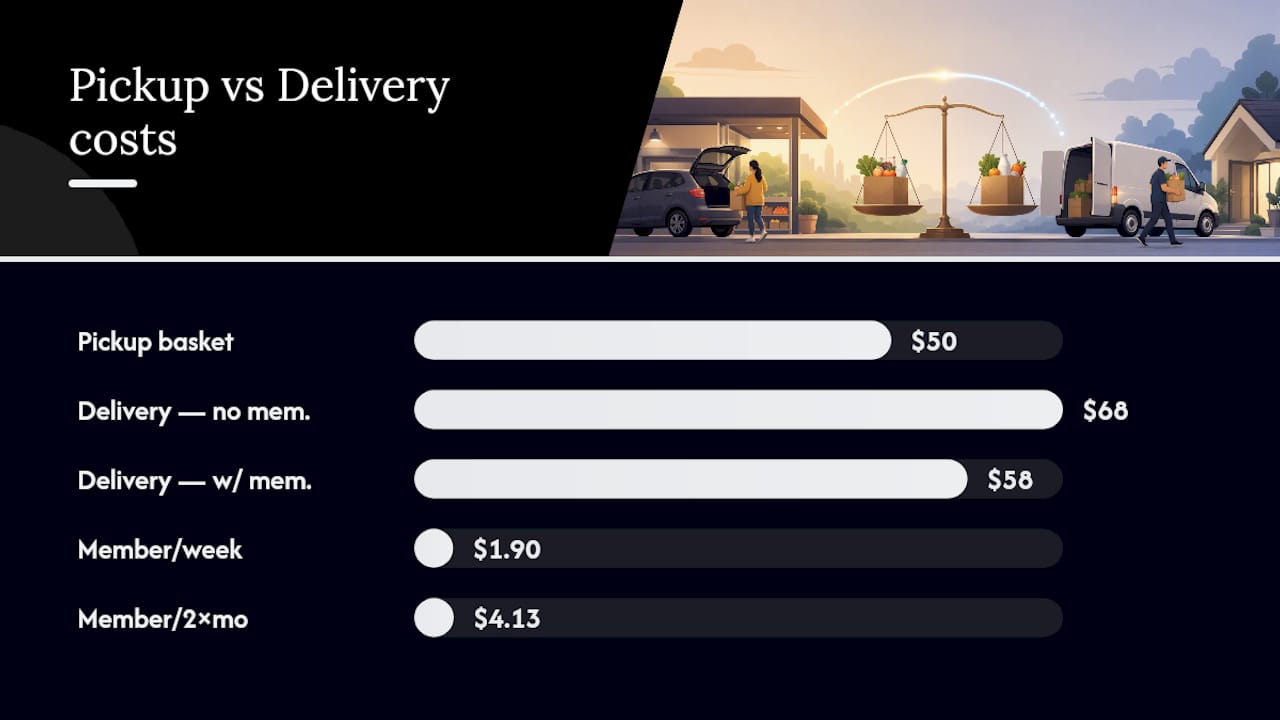
Here’s the simple version: a $50 basket picked up in-store costs about $50. The same basket delivered without a membership might cost around $68 after delivery fees and tips. With an amortized membership, that delivery basket cost could drop closer to $58.
How Freshness and Order Accuracy Change the Real Cost
Pickup lets you look at the produce before it leaves the store. Delivery leaves that judgment to a picker you’ll never meet, and that gap in control matters more than most people budget for.
Substitutions and missed items are the quiet cost of delivery. When your first-choice item is out of stock, a picker swaps it for something close enough, or skips it entirely. Either outcome can mean a second trip if the substitute doesn’t work for your recipe or your household won’t eat it.
You can model that risk with simple math: multiply the probability of a bad substitution by the added time and mileage cost of a fix-it trip.
A few habits shrink that risk:
- Choose the earliest available pickup or delivery window so inventory hasn’t been picked over by other shoppers.
- Add specific notes on substitutions (“no substitute” for produce you’re picky about).
- Favor short lead times when possible, since fresher inventory tends to move faster.
Pro Tip: Check your produce for freshness the moment you get home, whether it came from a shelf or a delivery bag. Catching a soft avocado on day one beats discovering it mid-recipe on day three.
Is the Time You Save Worth What Delivery Costs?
Time has a price, even when it doesn’t show up on a receipt. A workable stand-in for that price is the U.S. median hourly wage, paired with the IRS standard mileage rate for whatever driving your trip requires.
Scheduling matters just as much as the math. Delivery usually means picking a window, sometimes same-day, sometimes a day or two out, and living with whatever happens if that window slips. Pickup works on a shorter leash: you reserve a slot, show up, and someone loads your trunk, often within minutes of your arrival.
Rough heuristics that hold up in most cases:
- Under 10 minutes round-trip and no active membership: pickup almost always wins.
- Long drive, tight schedule, or a membership you’re already paying for: delivery starts making sense.
- Missed pickup windows can mean rebooking or restocking delays, so build in a buffer if your day is tight.
A Step-by-Step Way to Decide Between Pickup and Delivery Groceries
Run this quickly before you place your next order, and you’ll stop guessing.
- Estimate your drive time and mileage to the store you’d use for pickup or in-store shopping.
- Convert that time into a dollar value using your own hourly rate or the median wage as a stand-in.
- Add mileage cost using the IRS standard rate.
- List every delivery-side fee: delivery fee, service fee, bag fee, and expected tip.
- Factor in membership amortization if you’re paying for one, dividing the annual cost by your realistic number of orders this year.
- Estimate second-trip risk as a rough probability times the cost of a fix-it run.
- Add up both totals and pick whichever number is lower.
The decision rule is simple: whichever total is smaller wins. If you’re under a few miles from the store, have no active membership, and your time isn’t especially tight, pickup usually comes out ahead. If you’re paying $99 a year for a membership and ordering weekly, delivery often pulls ahead once that fee is spread thin.
Pro Tip: Watch for order minimums and promotions that waive delivery fees. Many retailers drop the fee entirely above a certain basket size, which can flip your calculation without changing a single habit.
Does Pickup or Delivery Have a Smaller Environmental Footprint?
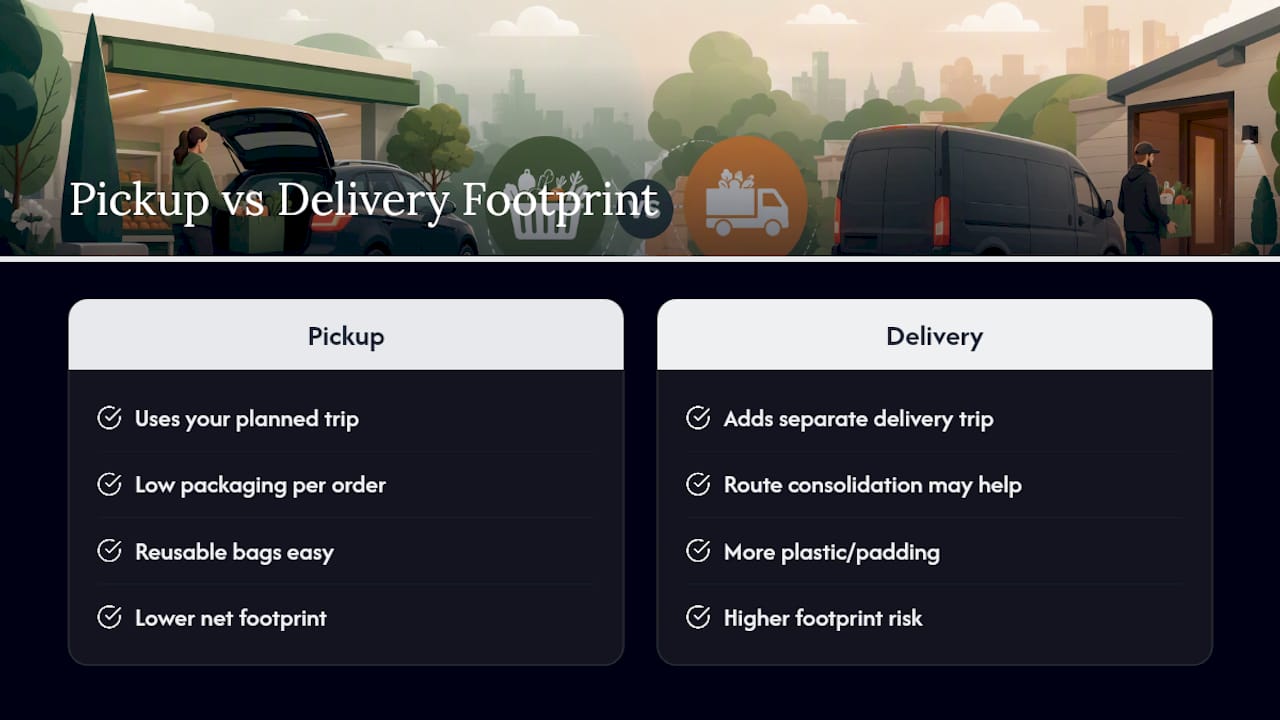
Pickup generally leaves a lighter footprint, mostly because it avoids adding a dedicated delivery trip on top of a car trip you were likely making anyway. When you pick up your own groceries, you’re consolidating a single vehicle trip you’d probably take regardless, for errands, work, or other stops.
Delivery adds a separate vehicle trip solely for your order, and often for several other orders on the same route, which can offset some of that extra mileage through route consolidation. The net effect depends heavily on how many stops a driver makes per trip and how far apart those stops are.
Packaging is the other side of the ledger. Delivery orders tend to arrive in more plastic bags and extra padding to protect items during transit and multiple handoffs. Pickup orders, loaded directly into your own bags or bins at the curb, typically involve less packaging waste per order.
If cutting your footprint matters as much as cutting your bill, pickup usually serves both goals at once: fewer dedicated vehicle trips and less packaging per order. Bringing your own reusable bags to a pickup slot closes the gap even further, something that’s harder to arrange with a delivery driver working through a route on a schedule.
How Pickup and Delivery Compare on Contactless Safety Options
Both formats now offer contactless options as a standard feature rather than a pandemic-era workaround. Curbside pickup typically means a staff member loads your trunk while you stay in the car, minimal contact by design. Delivery drivers can leave orders at your door with a photo confirmation or text alert, skipping the handoff entirely.
The bigger safety difference is exposure, not protocol. Pickup means one trip into a parking lot, usually without entering the building. Delivery means zero trips for you, which matters if you’re managing a health condition, recovering from an illness, or simply trying to avoid crowds during peak shopping hours.
Neither option requires much planning to stay contactless today. Most apps let you flag “leave at door” or “contactless pickup” as default preferences, so the safety layer runs in the background without extra steps on your part.
Which Option Gives You Better Selection and Stock Availability?
Selection depends more on the retailer’s inventory system than on whether you choose pickup or delivery, but the two formats do behave differently when something runs out.
Pickup orders are assembled from the same real-time inventory a shopper would see walking the aisles, so what’s on the shelf is generally what you get. Delivery orders pulled through third-party platforms sometimes draw from inventory feeds that lag slightly behind in-store stock, which is part of why substitutions show up more often on delivery orders.
Specialty items are where this gap widens. Imported or niche products, the kind that make up a big share of Caribbean and international grocery inventory, don’t always sync perfectly across every platform’s stock feed. If you’re shopping for specific brands or hard-to-find items, checking availability directly through a retailer’s own site or app tends to be more reliable than a third-party delivery app pulling from an older snapshot.
Which Format Actually Feels Easier to Use Day to Day?
App and website usability varies more by retailer than by format. A clunky pickup interface and a clunky delivery interface both create the same headache: hunting for items, fighting a bad search function, and second-guessing whether your order actually went through.
What tends to separate good experiences from bad ones is friction at checkout. Pickup apps that let you select a specific arrival window and get a clear notification when your order is ready create less anxiety than apps that leave you guessing. Delivery apps that show a live map of your driver’s location reduce the “did this actually happen” uncertainty that comes with handing your order to someone you can’t see.
Customer satisfaction research on delivery services consistently points to communication, not speed, as the deciding factor. Shoppers tolerate a slightly late order far better than a silent one.
Does Choosing Pickup or Delivery Affect Local Stores?
Where you shop matters as much as how you shop. A pickup or delivery order placed with a local retailer keeps that revenue circulating in your community, supporting jobs and inventory decisions made by people who actually live there. An order placed through a large national chain or a third-party delivery platform routes a chunk of that same spending toward corporate overhead and platform fees instead.
This distinction matters more for specialty grocers than for big-box stores. A store built around a specific community’s needs, whether that’s Caribbean staples, regional produce, or imported pantry items, depends on local shoppers choosing to buy there directly rather than defaulting to whichever national chain shows up first in a delivery app. Every pickup or delivery order placed with an independent or regional grocer is a small vote for that store’s ability to keep carrying items you can’t easily find elsewhere.
Budget-conscious shopping and community-conscious shopping aren’t in conflict here. Local retailers offering their own pickup and delivery programs, rather than routing exclusively through third-party platforms, often keep fees lower precisely because there’s no middleman markup to cover.
Why We Push Pickup First at Tojexpress
Running a convenience grocery business means watching this cost equation play out with real customers every week. Shoppers who try pickup first almost always come back to it, not because delivery is bad, but because the math rarely favors it for a single order. If you’re weighing pickup against delivery for the first time, start with a pre-packed pickup order and see how the savings actually feel.
— ANTONIO
Try Curbside Pickup With Tojexpress and Keep More of Your Grocery Budget
Tojexpress offers online ordering with curbside pickup that skips the delivery fees, service charges, and tip pressure that inflate a typical delivery order by $10 or more, and also features offerings from the best online coffee roasters to enhance your shopping experience. That’s the real advantage for budget-conscious shoppers: you get the same American and Caribbean groceries, snacks, and household essentials you’d order for delivery, minus the fees stacked on top just for someone else to drive them to you.
Pickup means you choose your window, drive over on your own schedule, and load your own trunk in minutes. No membership to amortize, no tip calculation, no waiting on a delivery slot that might slip. If you’ve never ordered online before, the step-by-step guide to ordering in Atlanta walks through the whole process in a few minutes. Place your next order for pickup and see the difference on your receipt for yourself.
Sources
- Grocery prices in person, for pickup, for delivery: What we found – NBC4 Washington
- Is buying online or in-store cheaper? Comparing US grocery prices – NBC New York
- Grocery delivery pros, cons and costs of having someone else do your shopping – Checkbook