
Why American Brands Matter: Culture, Trust, and Value
TOJEXPRESS.COM-Antonio HenryTL;DR:
- American brands are valued globally for their trust, cultural significance, and economic contributions within the U.S. and abroad.
- Despite declining national credibility, U.S. brands like Apple and Google continue to grow in value, often driven by sustainability and local relevance.
- Buying American supports domestic jobs, quality standards, and community investment, emphasizing long-term value and cultural identity.
American brands are defined by their ability to combine cultural identity, economic power, and consumer trust into a force that shapes buying decisions at home and abroad. Apple, Microsoft, and Google alone represent hundreds of billions in brand value, and they are just the tip of a much larger story. The question of why American brands matter goes deeper than logos and slogans. It reaches into how people choose what to buy, who they trust, and what they want their purchases to say about them. Understanding that connection gives you a real advantage as a consumer.
Why American brands matter: trust drives every purchase
Brand trust is the single most powerful force in the American consumer market. 81% of U.S. consumers require trust in a brand before they will buy from it. That number is not just high. It is higher than in most other developed markets, where price or novelty often wins.
The benefits of American brands are built on this trust foundation. When a brand consistently delivers on its promise over years or decades, it reduces the mental effort a buyer needs to make a decision. That reduction in friction is worth real money. Brand recognition increases purchase likelihood by up to 80%, which means a familiar American brand on a shelf beats an unknown alternative almost every time.
American brands and consumer loyalty are tightly linked in ways that other markets simply do not replicate. Research from the International Business Review confirms that brand and relationship equity drive loyalty far more in Western markets, especially the U.S., than in Eastern markets. American consumers build relationships with brands the way they build relationships with people: slowly, based on repeated positive experiences.
The financial proof is clear. 75% of U.S. consumers stay loyal to trusted brands even when prices rise, and they are willing to pay about 25% more for a brand they trust. That premium is not irrational. It reflects the real cost of switching to an unknown product and risking a bad experience.
Pro Tip: When you are choosing between two similar products, look for the brand with the longer track record in the U.S. market. Longevity signals consistency, and consistency is what earns that trust premium.
Key behaviors that reflect American brand loyalty:
- Consumers return to trusted brands even after price increases
- Familiar brands reduce decision fatigue at the point of purchase
- Long-term brand consistency lowers customer churn and increases lifetime value
- Trust translates directly into word-of-mouth referrals
What is the economic impact of buying American?
The importance of American brands extends well beyond the individual purchase. When you buy from a domestic brand, you support a supply chain that employs American workers, pays American taxes, and reinvests in American communities. That chain of effects is measurable and significant.
One-third of U.S. homeowners factor the “Made in U.S.” origin into their home improvement purchases. They are not doing it out of blind patriotism. They associate domestic sourcing with quality, durability, and accountability. A product made in the U.S. is subject to American labor standards and quality controls, which gives buyers a concrete reason to trust it.
The food and beverage sector tells a similar story. American food brands like those you find at local Atlanta retailers are not just products. They are part of community identity. When a neighborhood store stocks American brands, it signals cultural familiarity and economic solidarity.
Here is how the economic impact of buying American plays out across categories:
- Jobs and wages. Domestic production supports manufacturing jobs that pay above-average wages in sectors like food processing, appliances, and tools.
- Tax revenue. American companies pay federal, state, and local taxes that fund schools, roads, and public services.
- Supply chain resilience. Domestic sourcing reduces dependence on foreign supply chains, which proved critical during global disruptions in recent years.
- Community investment. American brands often sponsor local events, support charities, and invest in the regions where they operate.
- Innovation spillover. American tech and manufacturing brands generate patents and research that benefit the broader economy.
Consumer preference for domestic brands also shifts with political climate. After nationalist surges, advertising effectiveness for domestic brands improves while foreign brands see lower advertising returns. That dynamic shows how deeply cultural and political identity is woven into purchasing behavior.
Pro Tip: Check product labels for “Made in USA” certification when shopping for tools, cookware, or appliances. These categories show the clearest quality and durability advantages from domestic manufacturing.
How do American brands lead globally despite trust challenges?
The paradox at the center of American brand power is striking. The top 500 U.S. brands grew 10% in value year over year to reach $6.44 trillion in 2026, led by Apple, Microsoft, and Google. At the same time, the U.S. dropped 4.6 points in the Global Soft Power Index 2026. Brand value and national credibility are moving in opposite directions.
That gap matters for any consumer or business thinking about the long-term influence of American brands. A brand can be enormously valuable in financial terms while the country it represents faces skepticism abroad. The brands that survive this tension are the ones that invest in local fluency, meaning they adapt their messaging and operations to the communities they serve rather than relying on American prestige alone.
“Economic power of American brands contrasts with declining national credibility; trust must be earned locally for sustained influence.” — Brand Finance Global Soft Power Index 2026
American tech brands have found one way to hold global trust: sustainability. Google and Apple score highest in the Brand Finance Sustainability Perceptions Index 2026. Consumers worldwide associate these brands with environmental responsibility, which offsets some of the national credibility decline.
| Brand category | 2026 brand value trend | Global trust trend |
|---|---|---|
| U.S. top 500 overall | Up 10% to $6.44 trillion | Declining (Soft Power Index down 4.6 pts) |
| Apple, Microsoft, Google | Leading growth drivers | High sustainability perception scores |
| Foreign brands in U.S. | Facing lower ad ROI | Losing ground to domestic preference |
American-made vs. imported: which offers better lifetime value?
Price is not the same as cost. That distinction is where American-made products most often win. A cast iron skillet from Lodge Manufacturing costs more upfront than an imported alternative. But it lasts decades with minimal care, while cheaper imports often warp, chip, or rust within a few years. The total cost of ownership tells a completely different story than the sticker price.
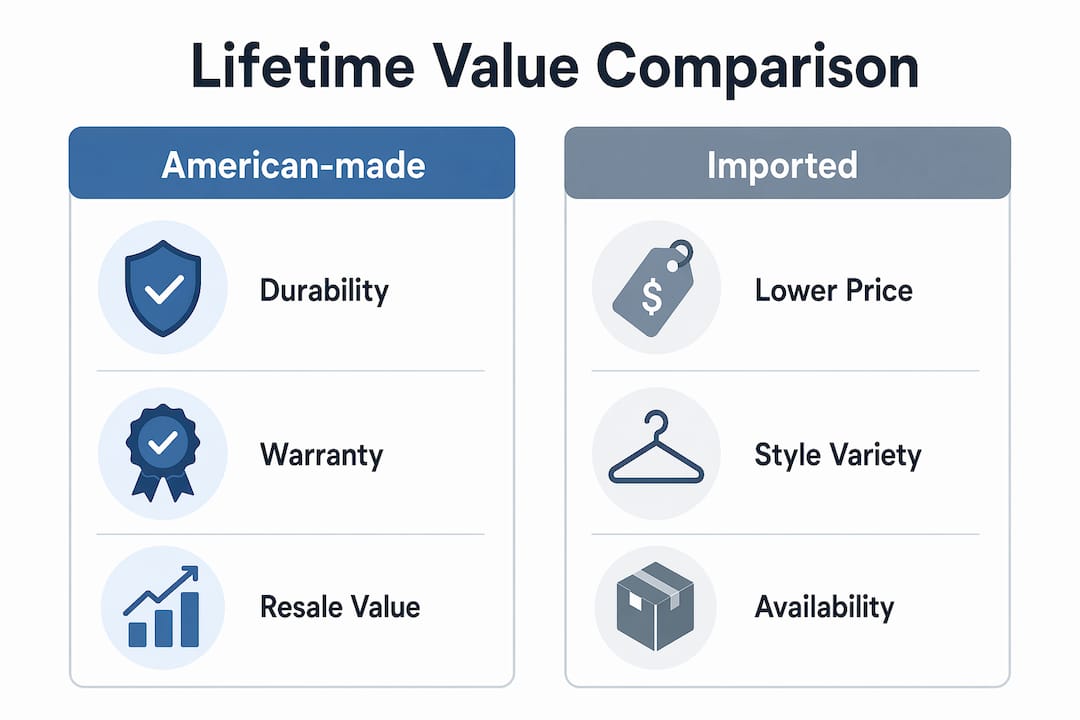
American-made products deliver superior lifetime value in categories like tools, cookware, and appliances. The reason is straightforward: domestic manufacturers face stricter quality standards and higher labor costs, which push them to build products that justify their price through durability. An imported tool that fails after two years and needs replacement has already cost you more than the American-made version that lasts ten.
| Category | American-made advantage | Imported advantage |
|---|---|---|
| Hand tools | Durability, warranty support | Lower upfront cost |
| Cookware | Longevity, material quality | Price accessibility |
| Appliances | Serviceability, parts availability | Entry-level pricing |
| Apparel | Labor standards, material sourcing | Fast fashion pricing |
Sophisticated buyers assess lifetime ownership costs before making purchasing decisions. This approach is especially relevant for products you use daily or rely on professionally. A contractor who buys American-made hand tools is not paying more. They are paying once instead of three times.
Imported products do win in some categories. Fast fashion, disposable electronics, and single-use items often make more financial sense to buy at lower cost and replace. The key is knowing which category you are shopping in before you decide.
Pro Tip: Before buying any product you expect to use for more than two years, calculate the cost per year of use for both the American-made and imported options. The math usually favors domestic manufacturing.
How do American brands shape cultural identity?
American brands are symbols before they are products. When someone wears a pair of Levi’s, carries a Yeti cooler, or drinks a Coca-Cola, they are making a statement about values: independence, quality, and a connection to American culture. That symbolic layer is a core part of why support for American companies runs so deep among certain consumer segments.

36% of consumers want to support local businesses, and local fit matters more than price in brand preference according to McKinsey’s State of the Consumer report. That preference is not just economic. It is psychological. Buying from a brand that reflects your community’s values gives you a sense of participation and belonging.
The psychological dimension goes further. Domestic brands offer consumers a sense of control and reduced risk, especially during times of uncertainty. When the economy is volatile or global supply chains are disrupted, buying American feels like a safer, more predictable choice. That perception of control is a genuine driver of loyalty, not just a marketing talking point.
American brands in food, apparel, and tech each carry distinct cultural signals:
- Food brands like those found at American grocery retailers connect consumers to regional traditions and shared culinary identity
- Apparel brands like Levi’s and Carhartt signal working-class authenticity and durability
- Tech brands like Apple and Google represent innovation, aspiration, and global connectivity
- Beverage brands like Coca-Cola and Snapple carry decades of cultural memory tied to American life
The emotional connection between consumers and American brands is not manufactured by advertising alone. It is built through consistent product experiences, community presence, and the sense that a brand shares your values.
Key Takeaways
American brands hold their position through a combination of trust, cultural resonance, and measurable economic value that no single factor alone could sustain.
| Point | Details |
|---|---|
| Trust drives purchase decisions | 81% of U.S. consumers require brand trust before buying, making trust the top purchase driver. |
| Domestic sourcing signals quality | One-third of U.S. homeowners factor “Made in U.S.” origin into purchases for quality and durability reasons. |
| Brand value keeps growing | U.S. top 500 brands reached $6.44 trillion in 2026, a 10% year-over-year increase. |
| Lifetime cost favors American-made | American-made tools, cookware, and appliances typically cost less per year of use than imported alternatives. |
| Cultural identity amplifies loyalty | Consumers connect American brands to values like independence and community, deepening emotional loyalty. |
American brands: trust is the real competitive advantage
I have spent years watching consumers make purchasing decisions, and the pattern is always the same. People do not buy the cheapest option when they have a real stake in the outcome. They buy the brand they trust. American brands have spent decades building that trust through consistent quality, cultural presence, and community investment. That is not easy to replicate.
What concerns me is the gap between brand value and national credibility. The numbers show American brands growing in financial value while the U.S. loses ground in global soft power. That gap will eventually close, and not necessarily in the direction brands want. The companies that will survive that shift are the ones investing in local relevance right now, not coasting on American prestige.
The brands I respect most are the ones that treat trust as a long-term asset rather than a short-term marketing tool. They show up consistently, they stand behind their products, and they connect with the communities they serve. That approach works whether you are Apple or a small American food brand on a convenience store shelf. The scale is different. The principle is the same.
Consumers are also getting smarter about lifetime value. The shift away from cheap imports in categories like tools and cookware is real and growing. People are doing the math and realizing that buying American once beats buying imported twice. That trend benefits everyone who makes quality a priority.
— ANTONIO
Discover authentic American brands at Tojexpress
Tojexpress carries a curated selection of American products chosen for quality, authenticity, and cultural connection. Whether you are looking for trusted food brands, beverages, or everyday staples, the store brings the best of American and Caribbean products together in one place.
The benefits of American brands are real: better lifetime value, stronger quality standards, and a cultural connection that imported alternatives simply cannot match. Tojexpress makes it easy to shop those brands without searching through a dozen different stores. Visit Tojexpress to explore the full selection and find the American brands you already trust alongside new ones worth discovering.
FAQ
Why do American brands command higher prices?
American brands command higher prices because consumers trust them and associate them with consistent quality. Research shows buyers willingly pay about 25% more for brands they trust, making the premium a reflection of earned loyalty rather than marketing alone.
What makes American-made products worth the cost?
American-made products typically deliver better lifetime value in categories like tools, cookware, and appliances because domestic manufacturing standards prioritize durability. The cost per year of use is often lower than imported alternatives that require earlier replacement.
How do American brands influence cultural identity?
American brands like Levi’s, Coca-Cola, and Apple function as cultural symbols that connect consumers to values like independence, innovation, and community. Buying these brands is a way of expressing identity, not just making a purchase.
Why is brand trust stronger in the U.S. than in other markets?
Brand and relationship equity drive loyalty more strongly in the U.S. than in Eastern markets, according to International Business Review research. American consumers build long-term relationships with brands based on repeated positive experiences, which makes trust a more powerful purchase driver here than almost anywhere else.
How are American brands performing globally in 2026?
The top 500 U.S. brands grew 10% in combined value to $6.44 trillion in 2026, led by Apple, Microsoft, and Google. However, the U.S. dropped 4.6 points in the Global Soft Power Index, showing that financial brand strength and national credibility are not moving in the same direction.