
The Real Role of Local Retail in Your Community
TOJEXPRESS.COM-Antonio HenryTL;DR:
- Shopping locally keeps nearly three times more money circulating in the community than buying from big-box chains. Local stores also create more jobs, support cultural identity, and serve as vital access points during emergencies. However, rising costs and retail concentration issues pose challenges that communities must navigate to sustain vibrant local retail ecosystems.
Spend a dollar at a big-box chain and most of it leaves your neighborhood before the day ends. Spend that same dollar at a local independent store and nearly three times more stays circulating in your local economy. That single fact reframes everything you thought you knew about where to shop. The role of local retail stretches far beyond price comparisons and parking convenience. It shapes jobs, cultural identity, emergency preparedness, and the social fabric that holds neighborhoods together. This article breaks down exactly how.
Table of Contents
- Key Takeaways
- The role of local retail in community economics
- Local retailers as social and cultural anchors
- Accessibility and emergency logistics
- Challenges and nuances worth knowing
- My take: local retail is a community investment
- Tojexpress and the value of shopping local
- FAQ
Key Takeaways
| Point | Details |
|---|---|
| Economic multiplier effect | Local retailers return nearly three times more money per dollar to the local economy than national chains. |
| Social infrastructure value | Local stores anchor neighborhood routines, social bonds, and community health beyond just selling goods. |
| Emergency access lifeline | Small local shops provide critical access to essentials within a 5-minute walk during crises. |
| Retail mix matters | Not all local retail benefits communities equally; overconcentration of certain store types can create unintended problems. |
| Hybrid models drive survival | Local retailers combining commerce with community services are proving the most resilient in 2026. |
The role of local retail in community economics
When people debate whether to shop local, the conversation almost always gets stuck on price. But price is the smallest part of the equation. The real story is about where money goes after you spend it.
Local independent retailers return nearly three times as much money per dollar of sales to the local economy compared to national chain competitors. That difference exists because independent owners tend to hire locally, bank locally, source from nearby suppliers, and reinvest their profits into the same zip code where they operate. A chain store, by contrast, funnels a significant portion of each sale to corporate headquarters, remote shareholders, and centralized distribution networks far from your neighborhood.
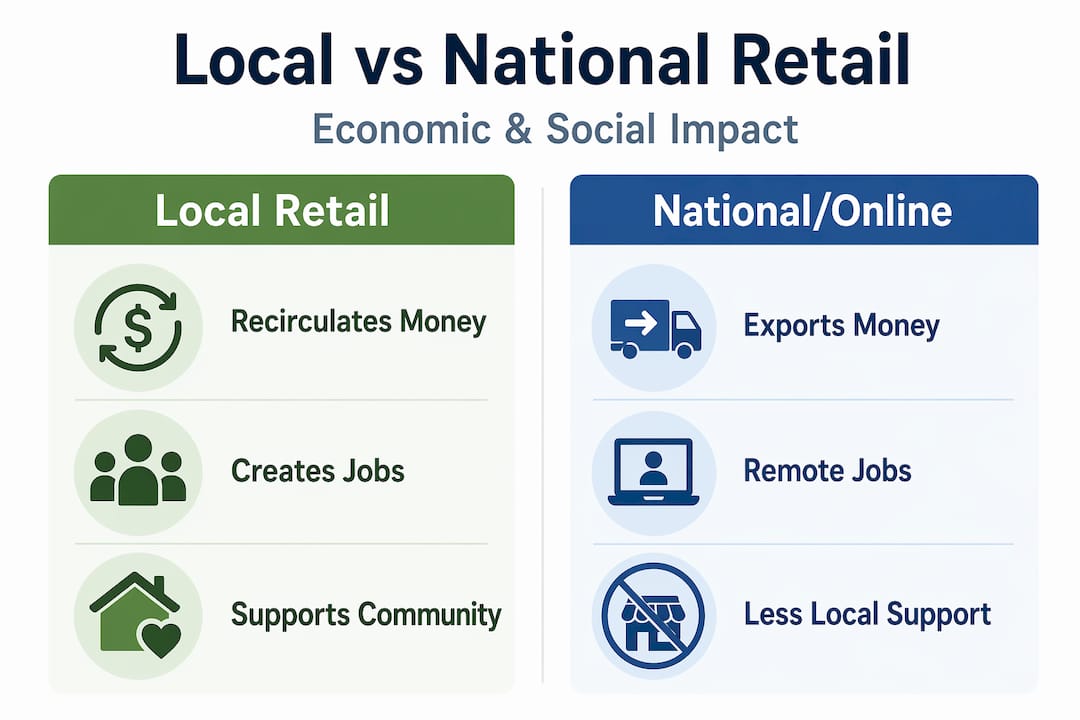
Job creation tells a similar story. Local businesses create roughly three times as many jobs as major online retailers for the same revenue. Those aren’t just any jobs either. They tend to be accessible, community-embedded positions that don’t require relocating or competing with a national applicant pool.
| Factor | Local Independent Retail | National Chain / Online Retailer |
|---|---|---|
| Money recirculated locally | High (approx. 3x more per dollar) | Low (majority leaves community) |
| Local jobs per revenue dollar | High | Low |
| Local tax contributions | Direct and localized | Often minimized through corporate structures |
| Supplier relationships | Local and regional | Centralized and national |
| Owner reinvestment in area | Typical | Rare |
Local retailers also contribute meaningfully to municipal tax bases. Property taxes, business license fees, and local sales tax collections from independent stores fund schools, road repairs, and public services that residents use every day. When a local shop closes, that tax contribution disappears too.
Pro Tip: When you compare prices between a local store and an online retailer, factor in shipping costs, return hassle, and the community tax contribution. Total cost of ownership often tips in favor of local shopping more than you’d expect.
Local retailers as social and cultural anchors
Think about the last time you ran into someone you knew at a neighborhood store. That interaction probably felt incidental. It wasn’t. Those casual encounters are exactly what researchers mean when they talk about local retail as social infrastructure.
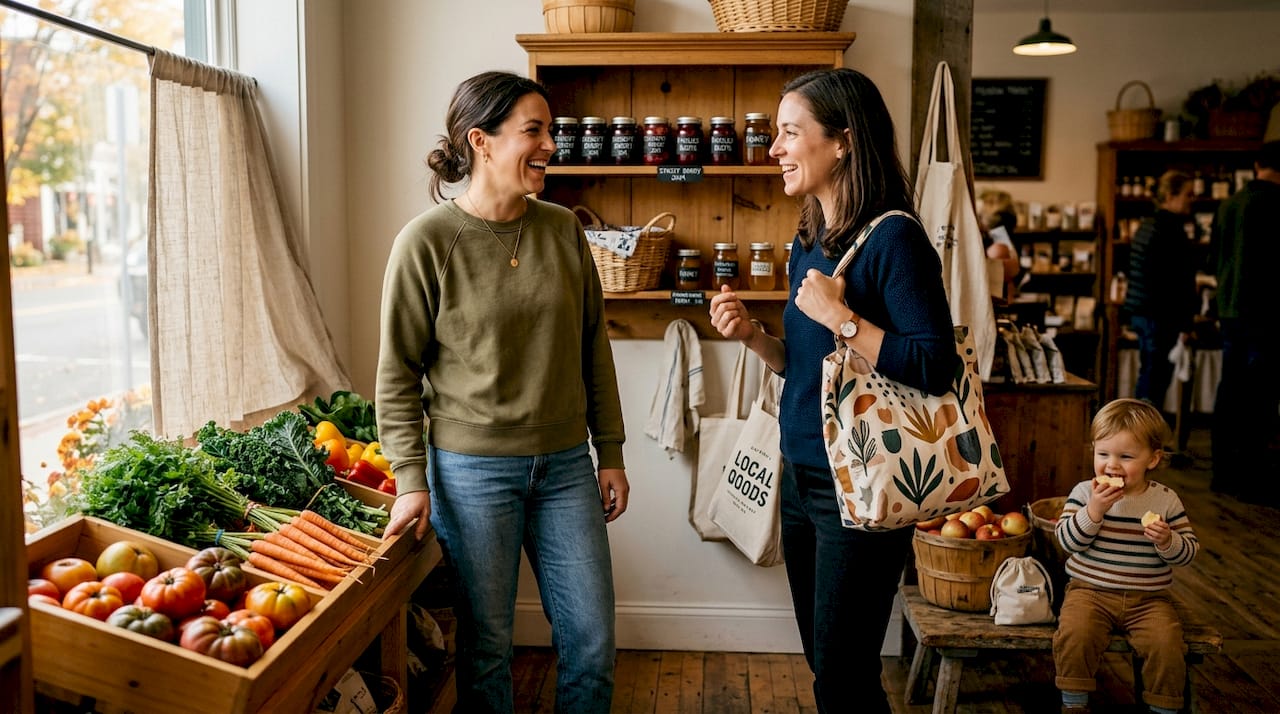
Store closures reduce casual social contacts and daily interactions, weakening community bonds in ways that are hard to quantify but deeply felt. When a neighborhood grocery store or corner shop closes, residents lose more than a convenient place to buy milk. They lose a predictable space where community life happens organically.
The evidence on what comes after a closure is sobering. Residents report:
- Increased feelings of isolation and disconnection from neighbors
- Greater reliance on processed or unhealthy foods from convenience chains
- Longer travel times for basic necessities, particularly affecting elderly and car-free residents
- A measurable decline in neighborhood foot traffic that ripples into other nearby businesses
Local retailers also carry cultural weight that chains simply can’t replicate. A Caribbean grocery in a Miami neighborhood or an American specialty food store in an Atlanta suburb doesn’t just sell products. It preserves flavor traditions, supports cultural identity, and gives immigrant and diaspora communities a tangible connection to their heritage. You can learn about Atlanta’s food heritage and how local stores have served over 5,500 residents to understand just how deep that connection runs.
“Local retailers offer personalized advice and blended online-offline operations, creating experiences that big chains simply can’t replicate.” — New Canaan Nite
The most forward-thinking local retailers are taking this social role even further. Hybrid retail models that use physical store space for art galleries, community events, pop-ups, and neighborhood markets are proving both popular and financially resilient. The store becomes a venue. The transaction becomes secondary to the relationship.
Accessibility and emergency logistics
Here’s a dimension of local retail that rarely comes up until people need it most: emergency access.
When a hurricane, ice storm, or public health crisis disrupts supply chains, the stores people can reach on foot or by bicycle become critical. Local micro-retailers offering goods within a 5-minute walk significantly improve community access during crises. A case study from the Zhoushan Archipelago found that local shops handled 32% of essential goods distribution during emergencies. That is not a small number. That is a third of what kept people fed and supplied when larger systems broke down.
Outside emergencies, proximity matters daily for millions of Americans who don’t own cars, have mobility limitations, or live in neighborhoods where the nearest big-box store requires a 30-minute bus ride. The importance of local retail for these populations isn’t abstract. It’s the difference between eating fresh food and not.
Here’s how local retail addresses accessibility in practical terms:
- Proximity reduces barriers. A corner store within walking distance serves residents who can’t or don’t drive, including elderly residents, people with disabilities, and low-income households without reliable transportation.
- Small-format stores fight food insecurity. Programs like Detroit’s Green Grocer initiative support 18 stores providing fresh, affordable food tailored to neighborhood needs.
- Local sourcing during disruptions. When regional supply chains fail, locally stocked stores draw on nearby suppliers and can restock faster than chains dependent on national distribution.
- Community resilience programs. City-led grants and support programs increasingly recognize local retail as critical public infrastructure rather than just private enterprise.
| Community Need | How Local Retail Responds |
|---|---|
| Food deserts | Small-format stores offer fresh produce in underserved areas |
| Emergency access | 5-minute walkability provides goods when transit fails |
| Cultural food access | Specialty stores carry products national chains don’t stock |
| Senior and disabled access | Proximity and personalized service reduce barriers |
Pro Tip: If you live in or near a food-insecure neighborhood, look for city programs that support local grocery stores. Advocating for those programs at city council meetings has more direct impact than most people realize. Check how Atlanta neighborhood stores are tackling this issue for a concrete example.
Challenges and nuances worth knowing
The importance of local retail is real, but it isn’t unconditional. A balanced view requires acknowledging where the picture gets complicated.
Rising costs are the most immediate threat. Rent increases, minimum wage adjustments, supply chain volatility, and the growing dominance of online retail all squeeze margins that independent stores can’t absorb the way corporations can. When a local retailer closes, it rarely reopens as another independent. It becomes a chain or stays vacant.
The retail mix question is trickier. Research shows that certain retail concentrations can negatively affect neighborhood safety and health outcomes. An overconcentration of dollar stores in low-income areas, for example, has been linked to higher crime rates and reduced access to fresh food because these stores crowd out full-service grocers. The presence of retail isn’t automatically positive. The type and mix of retail determines community outcomes.
What consumers can actually do about this:
- Support local retailers who carry fresh food, cultural products, or specialty goods that chains don’t offer
- Choose independent stores for regular purchases, not just special occasions
- Engage with local business associations that advocate for fair zoning and retail diversity
- Ask local retailers about their sourcing and community involvement. Retailers who prioritize local sourcing and sustainable practices deserve your loyalty
The good news is that footfall in local retail centers rose by 9% in 2026, with 61% of independent food retailers reporting growth. Consumers are already shifting. The retailers who combine genuine community integration with smart digital presence are the ones capturing that momentum.
Pro Tip: When a new local store opens in your neighborhood, visit within the first month. Early customers create the social proof that determines whether a new independent retailer survives past its first year.
My take: local retail is a community investment
I’ve watched neighborhoods transform in both directions. I’ve seen blocks come alive when a well-run independent food store opens, and I’ve watched a community slowly hollow out after its last local grocery closed. What strikes me most is how invisible the loss is until it’s complete.
People rarely say, “I’m going to miss the social interaction at that store.” They say, “I just need to find somewhere else to shop.” But six months later, they notice they don’t know their neighbors as well. The block feels quieter. Less safe. Less like a place worth sticking around for.
The contrarian view I’d push back on is the idea that convenience and low prices are the primary values consumers should optimize for. I’ve come to believe that convenience and community health are not separate calculations. The full value of a local store includes the job it provides your neighbor, the tax dollar that fixes the pothole on your street, and the cultural product it carries that reminds a family where they came from.
My experience tells me that the communities with the strongest local retail scenes are also the ones people want to move to, raise families in, and stay in long-term. That correlation is not a coincidence. It’s a signal worth acting on.
— ANTONIO
Tojexpress and the value of shopping local
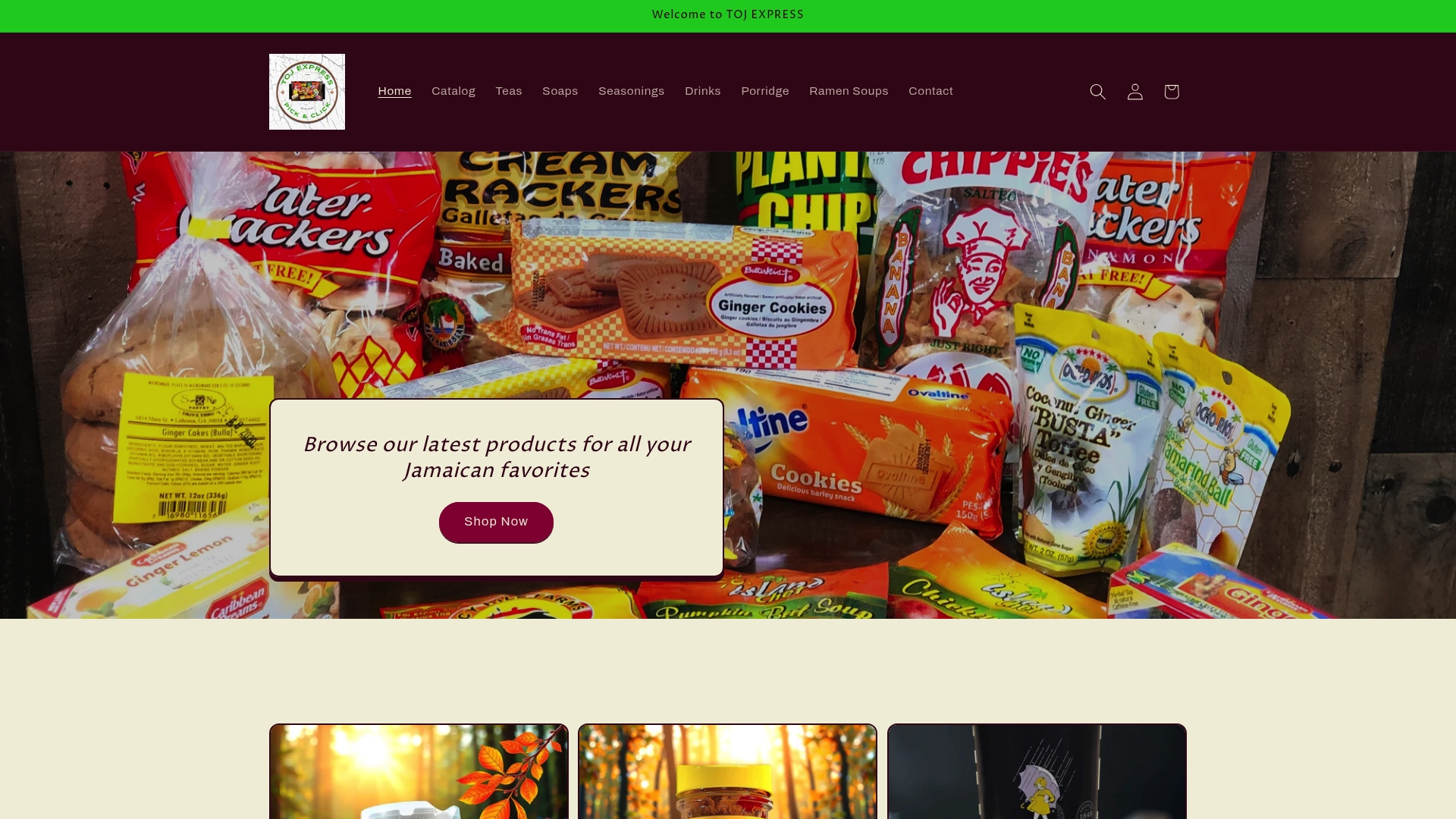
At Tojexpress, we live this reality every day. As a local convenience store carrying American and Caribbean products in the Atlanta area, we see firsthand how much community access to the right products matters. The families who walk through our door aren’t just shopping. They’re finding foods that connect them to home, to culture, and to each other.
If you want to understand more about how local stores like ours contribute to food access and community identity, explore our breakdown of why local stores matter for Atlanta suburban shoppers. You can also read about the benefits of American groceries and why choosing local makes a measurable difference for your neighborhood. Every purchase at a store like Tojexpress is a direct investment in the community you live in. Visit us at tojexpress.com to see what we carry and how we serve our neighbors.
FAQ
What is the role of local retail in the economy?
Local independent retailers return nearly three times more money per dollar of sales to the local economy compared to national chains, and they create significantly more jobs per dollar of revenue. This makes them a powerful driver of community wealth and employment.
How does local retail support communities beyond shopping?
Local stores act as social infrastructure by providing spaces where community members interact casually, which strengthens neighborhood bonds and safety. Research shows that when these stores close, residents experience increased isolation and reduced access to fresh, healthy food.
Why does local retail matter during emergencies?
Local micro-retailers offering goods within walking distance provide critical access to essentials when larger supply chains fail. Studies show local shops handled 32% of essential goods distribution during emergencies in some communities.
How can consumers support the local retail mix in their neighborhood?
Shoppers can prioritize independent stores that carry fresh food or specialty products, engage with local business advocacy groups, and participate in city programs that fund small-format grocery stores in underserved areas.
What challenges do local retailers face today?
Rising rents, online competition, and supply chain costs are the biggest pressures on independent retailers. Overconcentration of certain retail types, like dollar stores, can also harm neighborhood health outcomes, making retail diversity an active community concern rather than a passive one.