

The Real Role of Variety in Meals for Better Nutrition
TOJEXPRESS.COM-Antonio HenryTL;DR:
- Meal variety is essential for nutritional completeness, providing a broader spectrum of vitamins, minerals, and phytochemicals. Structured rotation and multicultural cuisines support long-term adherence and balance, whereas unstructured variety can lead to overeating. Combining consistent planning with deliberate ingredient swaps enhances nutrient intake while maintaining sustainable, enjoyable eating habits.
Most people think the role of variety in meals is about keeping dinner interesting. That’s only part of the story. The real case for meal variety is nutritional. When you eat the same foods on repeat, you pull from the same pool of vitamins, minerals, and phytochemicals every single day, leaving real gaps in your diet. This article breaks down what current research says about why diversifying your meals matters, how to do it without overeating or burning out on planning, and what practical strategies actually work in real life.
Table of Contents
- Key takeaways
- The role of variety in meals and why nutrition demands it
- When variety works against you
- Structured rotation: the smarter way to plan meals
- How to actually add more variety starting today
- My take on variety after years of watching people eat
- Explore variety with Tojexpress
- FAQ
Key takeaways
| Point | Details |
|---|---|
| Variety fills nutritional gaps | Rotating foods across meals covers a broader spectrum of vitamins, minerals, and phytochemicals you can’t get from a single food. |
| Too much variety can backfire | Studies show greater food variety in buffet settings can increase calorie intake by up to 75%, so structure matters. |
| Planning reduces decision fatigue | People who plan meals show 21% higher fruit and vegetable variety and better long-term nutritional adherence. |
| Rotate one or two components | Swapping just one protein or vegetable per meal keeps variety manageable without overhauling your entire routine. |
| Cultural diversity adds nutritional range | Multicultural cuisines naturally expand your ingredient list, bringing in flavors and nutrients you wouldn’t find in a single-culture diet. |
The role of variety in meals and why nutrition demands it
Taste is a side effect. The deeper reason to prioritize meal variety for nutrition is physiological. No single food, or even a handful of foods, can supply everything your body needs to function well over time.
Eating a variety of mostly plant-based foods links directly to better fiber intake and measurably lower risks of heart disease, cancer, and type 2 diabetes. That’s not a soft recommendation. It’s the nutritional logic behind every credible dietary guideline in 2026. Different foods carry different micronutrients, and your body needs all of them working together. You can’t stockpile last Tuesday’s vitamin C for next Friday’s deficiency.
Here’s what variety actually accomplishes at the cellular level:
- Micronutrient coverage: Different grains, proteins, vegetables, and fruits each carry a distinct micronutrient profile. Rotating them prevents the quiet deficiencies that build up silently over months.
- Phytochemical diversity: Eating five servings of different fruits and vegetables daily delivers a range of cardiovascular-protective phytochemicals that a single type simply can’t provide.
- Gut microbiome support: Diversifying plant-based foods supports microbiome diversity and the production of short-chain fatty acids, which reduce inflammation and support immune function.
- Chronic disease prevention: A pattern built around dietary variety and health links consistently to lower rates of the most common preventable diseases.
“Balance and variety is a foundational healthy diet principle emphasizing nutrient-dense food selections.” — Harvard Health
The critical point here is that variety works across your eating pattern, not just in one meal. Foods and drinks work synergistically across the day, meaning your breakfast choices interact with what you eat at lunch and dinner to either close nutritional gaps or leave them open.
When variety works against you
Here’s the uncomfortable side of the conversation. Variety in diet doesn’t automatically mean healthier choices. There’s solid behavioral science showing the opposite can happen when variety isn’t structured.
A study at Penn State found that buffets with 27 items led participants to select nearly 1,500 calories on average, compared to 850 calories at buffets with just 9 items. That’s a 75% increase driven entirely by choice volume. Faced with more options, people eat more. Not because they’re hungrier, but because novelty triggers appetite signals that portion sizes can’t easily override.
This matters if you’re planning varied meals without thinking about structure. Chasing variety through restaurant hopping or open-ended buffet-style eating can quietly undo nutritional goals.
Personality also plays a role here. Highly conscientious individuals added significantly fewer calories in high-variety settings than others. If you know you tend to lose track of portions when excited by food options, that’s useful information. You’re not broken. You’re just wired to respond more intensely to variety cues, and you need a slightly more deliberate system.
Pro Tip: If you eat out frequently, scan the menu once and commit to your order before reviewing it again. Limiting your deliberation time reduces the impulse to add items just because they’re available.
The takeaway isn’t to eat the same thing every day. It’s that environmental design and consumer awareness can control the tendency to overeat in high-variety settings. Structure your variety, and you get the benefits without the caloric cost.
Structured rotation: the smarter way to plan meals
The most practical model for getting variety right is structured rotation. This means keeping your meal timing and portion sizes consistent while swapping specific components on a schedule. You’re not reinventing dinner every night. You’re making targeted substitutions that expand nutritional coverage without creating decision fatigue.
Here’s a simple weekly rotation framework:
- Monday and Tuesday: Rotate your protein source. Chicken on Monday, beans or lentils on Tuesday.
- Wednesday and Thursday: Swap your grain. Brown rice on Wednesday, quinoa or farro on Thursday.
- Friday and Saturday: Switch your vegetable base. Cruciferous vegetables like broccoli or cauliflower one day, leafy greens or sweet potatoes the next.
- Sunday: Use leftovers creatively to build a new combination from the week’s ingredients.
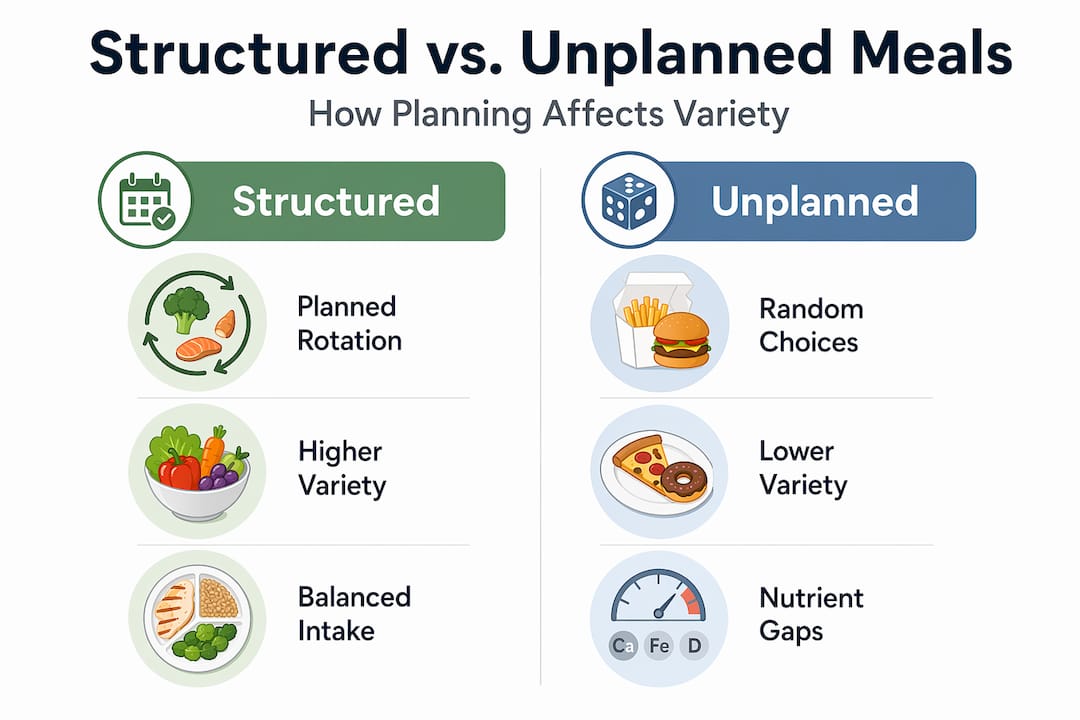
Meal planning with rotating food choices increases the odds of maintaining food variety by 25% and supports weight management at the same time. That figure makes sense when you see the mechanism. Planning removes the moment-of-hunger decision point where habit defaults win and variety loses.
Here’s a quick comparison to show why this approach beats the alternatives:
| Approach | Variety level | Calorie control | Sustainability |
|---|---|---|---|
| No planning, eat freely | High but random | Low | Low |
| Strict meal prep (same meals weekly) | Low | High | Moderate |
| Structured rotation | Moderate to high | High | High |

The structured rotation model wins on every axis that matters for the long term. People who plan meals systematically rotate proteins, vegetables, and grains for optimal nutrient intake while keeping portions predictable.
Pro Tip: Build your grocery list around a two-week ingredient cycle rather than a single week. This naturally forces you to buy different items every other week without requiring a full menu overhaul.
Seasonality adds another layer here. Buying produce that’s in season means your ingredient rotation follows a natural calendar. Winter squash replaces summer zucchini. Root vegetables rotate through spring greens. This kind of food diversity keeps meals fresh without effort and often lowers cost at the same time.
How to actually add more variety starting today
Knowing the benefits of how variety enhances meals doesn’t automatically change what ends up on your plate. Here are the approaches that create real, lasting shifts:
- Ingredient swapping within familiar recipes: Keep the structure of a meal you already make but sub one ingredient. Use sweet potato instead of white potato. Try ground turkey instead of beef. Swap spinach for kale. Each swap changes the nutrient profile without making cooking feel foreign.
- Lean into multicultural cuisines: This is one of the most underused strategies in everyday meal planning. Caribbean cooking brings scotch bonnet peppers, callaloo, and plantains, all carrying distinct nutritional profiles not common in standard American diets. Thai cuisine, for example, is built on balancing varied ingredients to achieve flavor harmony, which also naturally diversifies nutrient sources. Exploring multicultural foods expands both your pantry and your micronutrient range simultaneously.
- Diversify your snacks deliberately: Most people rotate their main meals more than their snacks, but snacks account for a meaningful portion of daily calories and nutritional input. Reaching for the same crackers or chips every afternoon is a habit, not a need. Rotating between nuts, fruit, hummus and vegetables, or Caribbean-style snacks changes what you get nutritionally from those calories.
- Use a simple ingredient tracker: Keep a running list of the vegetables, grains, and proteins you’ve eaten this week. When you see that you’ve had chicken four times, it’s easy to consciously choose something else. This small act of awareness is often enough to shift behavior.
Those who plan meals show 21% higher fruit and vegetable variety than those who don’t. That gap is entirely explained by awareness and intention, not cooking skill or access to exotic ingredients.
Pro Tip: Pick one new ingredient per grocery trip and build one meal around it. Over a month, you’ve added four new foods to your rotation with almost zero extra planning effort.
The importance of meal variety becomes most obvious when you start tracking what you actually eat. Most people discover they’re cycling through the same eight to ten foods on a two-week loop. Widening that loop by even three or four foods produces measurable nutritional gains.
My take on variety after years of watching people eat
I’ve seen two common failure modes when people try to improve their diets. The first is eating the same healthy foods in the same order every week and wondering why they plateau nutritionally or lose motivation. The second is overcorrecting by chasing novelty through constant restaurant meals, elaborate recipes, and trend-driven ingredient lists that don’t hold up past week two.
What I’ve learned is that consistency and variety aren’t opposites. They’re partners. You need consistent timing and portion habits to keep calories in check. You need rotating ingredients and cuisines to keep nutrients covered and meals satisfying. Neither works as well without the other.
The mistake I see most often is treating variety as a reward for “good” eating rather than a structural feature of the plan itself. People save interesting meals for weekends or special occasions and eat the same plain rotation during the week. That means they’re nutritionally monotonous for five days straight and then overstimulated by options on the other two.
Meal variety enhances psychological adherence by preventing dietary fatigue. That’s not soft science. When eating feels like a chore, you abandon the habit. When it feels like something worth doing, you sustain it. The best meal plan you’ll ever follow is the one that keeps you interested while meeting your nutritional needs. Building genuine variety into the structure of your weekly eating is the most effective way I know to accomplish both at once.
— ANTONIO
Explore variety with Tojexpress
If you’re ready to put these ideas into practice, the products you stock at home make all the difference.

Tojexpress carries a curated selection of American and Caribbean groceries specifically suited for people who want to cook with more range. From diverse grocery staples like grains, canned goods, and seasonings to a rotating lineup of snack options that go well beyond standard convenience store fare, Tojexpress gives you the raw ingredients to build a genuinely varied eating pattern. Whether you’re experimenting with Caribbean staples for the first time or looking to round out your weekly rotation, the snack diversity guide at Tojexpress is a solid starting point. Stock your kitchen with more range and your meals will follow.
FAQ
What is the role of variety in meals for health?
Variety in meals covers a broader range of nutrients, phytochemicals, and gut-supporting plant compounds than any single food pattern can. Dietary guidelines consistently link meal variety to lower risks of heart disease, diabetes, and cancer.
Can too much variety cause overeating?
Yes. Research shows that greater food variety in buffet settings raises calorie selection by up to 75%, so unstructured variety can work against health goals.
How does meal planning improve dietary variety?
People who plan meals show 21% higher fruit and vegetable variety than those who don’t, because planning creates intentional ingredient rotation rather than relying on habit and convenience.
How many different plants should I eat weekly?
Nutrition research increasingly points to eating a broad range of plant foods weekly as the benchmark for gut microbiome health, with 30 different plant sources cited as a practical target in recent guidelines.
What is the easiest way to add variety to meals?
Swap one ingredient per meal rather than overhauling your entire routine. Over time, these small substitutions add up to a genuinely diverse eating pattern without requiring complex meal planning or new cooking skills.