
Why Local Distribution Wins for Business Owners
TOJEXPRESS.COM-Antonio HenryTL;DR:
- Local distribution places inventory near customer clusters to cut delivery times and reduce logistics costs. It builds community loyalty by matching stock to local demand and offers resilience during supply disruptions. Managing inventory fragmentation through real-time data and demand analysis is crucial for success.
Local distribution is the strategic placement of inventory and fulfillment nodes near customer clusters to cut delivery times, lower logistics costs, and build genuine community ties. For business owners and entrepreneurs, understanding why local distribution works is the difference between competing on price alone and building a loyal customer base that keeps coming back. The model has moved from niche practice to mainstream strategy, driven by hard data on last-mile performance and shifting consumer expectations around speed and local connection.
Why local distribution outperforms centralized models on speed and cost
Placing inventory close to customers is not a branding choice. It is an operational decision with measurable financial consequences. Hyperlocal fulfillment networks within about 15 miles of population centers achieve a 73% same-day delivery success rate and reduce last-mile costs by up to 42%. That cost reduction alone can reshape the economics of a small or mid-sized distribution operation.
Micro-fulfillment centers, typically 3,000–15,000 square feet, positioned within roughly 10 miles of dense customer clusters cut average delivery times from 2.3 days to 14 hours. That is not a marginal improvement. It is a structural shift in what customers experience and what your logistics budget absorbs.
The key drivers behind these savings are straightforward:
- Shorter trip length reduces fuel consumption and driver hours per delivery
- Fewer handling touchpoints lower the risk of damage and delay
- Smaller, distributed facilities replace dependence on large central warehouses
- Faster replenishment cycles keep shelves stocked without overordering
Pro Tip: When selecting a fulfillment node location, prioritize demand density over geographic convenience. A facility placed where your customers actually concentrate will outperform one placed where real estate is cheapest.
Amazon’s middle-mile network applies this logic at scale. The company uses historical data and demand scenarios to stress-test inventory placement against spatial disruptions, not just average delivery conditions. The lesson for smaller operators is clear: location selection should be driven by customer concentration and carrier route geometry, not by what feels local.
How local distribution builds community engagement and supports local economies
Local distribution does more than move products faster. It connects your business to the communities it serves in ways that national or centralized models cannot replicate. Regional distribution improves inventory alignment with local buying habits, supports on-time deliveries, and keeps shelves stocked with products that match what local customers actually want.

The Locavana model demonstrates this at the consumer level. By sourcing from 40+ local farms and consolidating orders into a single checkout, Locavana reduced delivery layers and costs while making local food genuinely convenient. The model works because it treats logistics efficiency as the foundation of community connection, not an afterthought.
For businesses selling American and Caribbean products, like Tojexpress does in Atlanta, this principle translates directly. Stocking products that reflect the neighborhood’s food culture and distributing them through local channels builds the kind of trust that national chains struggle to manufacture. You can read more about how local retail supports communities and why that connection drives repeat business.
“Local distribution allows businesses to better match store-level inventory to local demand and retailer capacity, avoiding shelf flooding and supporting cash flow.” — Forbes Business Development Council
The sustainability angle matters too, especially for B2B buyers. Regional distribution reduces Scope 3 emissions by shortening trip lengths, lowering fuel use, and cutting exposure to multi-state handling. Sustainability-conscious buyers increasingly factor this into purchasing decisions, which means local distribution advantages extend beyond logistics into sales and supplier relationships.
The community benefits stack up across several dimensions:
- Local jobs: Distributed fulfillment creates employment closer to where people live
- Supplier relationships: Shorter supply chains support local producers and vendors
- Customer loyalty: Shoppers who feel served by their community spend more consistently
- Cultural alignment: Products and delivery timing match local preferences more accurately
What are the real challenges of local distribution strategies?
Local distribution is not without complexity. The biggest operational risk is inventory fragmentation. When stock is spread across multiple nodes, stockouts and overstock risks multiply unless SKU allocation between local and central inventory is managed with discipline. A product that sells fast in one neighborhood may sit untouched in another, and without real-time visibility, you will not catch the imbalance until it costs you.
Managing this well requires a structured approach:
- Map demand by location first. Before splitting inventory, analyze sales data by zip code or neighborhood to understand where each SKU actually moves.
- Set replenishment triggers at the node level. Each local facility needs its own reorder points, not a one-size-fits-all threshold from the central warehouse.
- Maintain a central buffer stock. Local nodes handle routine demand. The central inventory absorbs spikes, new product launches, and seasonal surges.
- Review SKU performance monthly. Products that underperform at a local node should be consolidated back to central stock rather than left to age.
- Build network resilience into your plan. Local distribution should be treated as a resilience architecture, not just a speed feature, to maintain performance under spatial disruptions.
Pro Tip: Integrate a real-time inventory visibility platform across all nodes before you scale. Tools like NetSuite, Fishbowl, or Cin7 give you a single view of stock levels across locations, which is the only way to manage fragmentation without constant manual audits.
Demand forecasting is the other discipline that separates successful local distribution from expensive experiments. Accurate forecasts at the local level require granular data, including neighborhood demographics, seasonal buying patterns, and local event calendars. The more specific your inputs, the more reliable your replenishment cycles become.
Local vs. regional vs. centralized distribution: which model fits your business?
Understanding the differences between distribution models helps you decide where local distribution fits in your overall strategy. Each model has a distinct cost profile, speed advantage, and risk exposure.
| Model | Speed | Cost | Risk | Best for |
|---|---|---|---|---|
| Local (hyperlocal) | Same-day to next-day | Low last-mile cost, higher node overhead | Inventory fragmentation | Dense urban markets, perishables, convenience retail |
| Regional | 1–2 days | Balanced fuel and handling costs | Moderate, manageable with forecasting | Mid-size markets, agribusiness, specialty retail |
| Centralized | 2–5 days | Low facility cost, high last-mile cost | Single point of failure, weather and disruption exposure | Low-frequency, high-margin, or bulky goods |
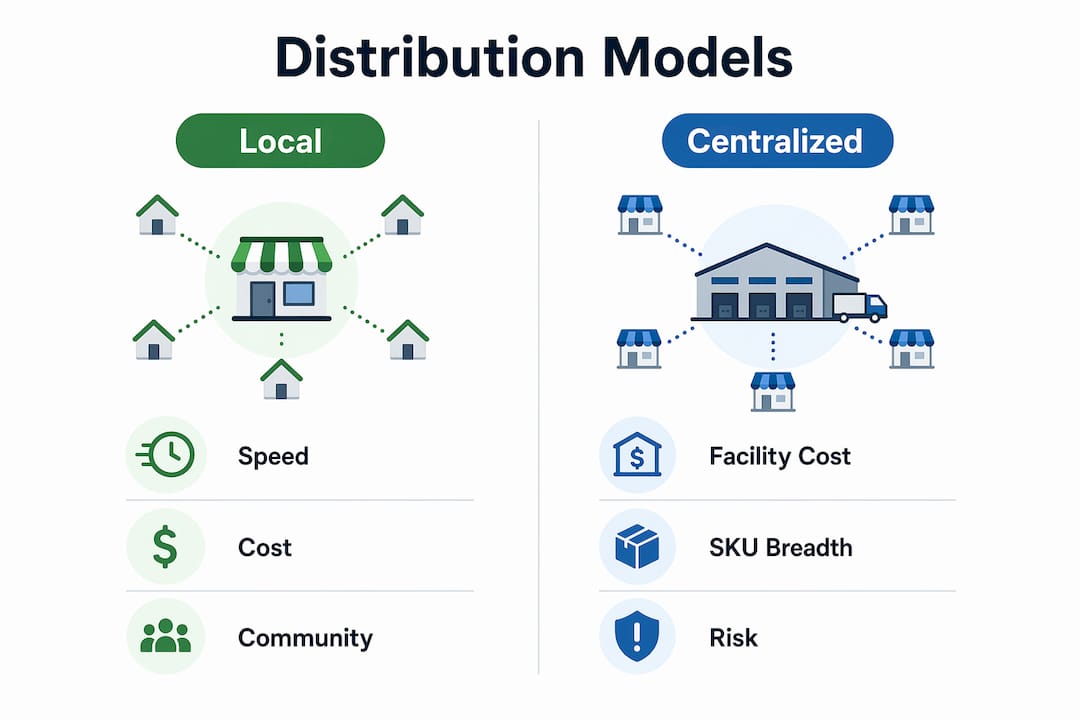
The local model wins on speed and community alignment. The centralized model wins on facility cost and SKU breadth. Regional distribution sits between the two and is increasingly the preferred structure for businesses that need both reach and responsiveness.
For a convenience store operator or specialty food retailer, the local model is almost always the right anchor. You are selling products that customers want today, not next week. The importance of local distribution for grocery and convenience supply chains comes down to one fact: shelf availability at the moment of demand is the product. If the shelf is empty, the sale is gone.
The decision between models is not permanent. Many businesses run a hybrid structure, using local nodes for fast-moving SKUs and a central facility for slower-moving or seasonal inventory. That split requires clear criteria for which products live where, and it requires the forecasting discipline described in the previous section.
Key Takeaways
Local distribution is most effective when inventory placement is driven by demand density, supported by real-time visibility tools, and treated as a resilience strategy rather than a simple speed upgrade.
| Point | Details |
|---|---|
| Speed and cost gains are measurable | Hyperlocal networks cut last-mile costs by up to 42% and delivery times from 2.3 days to 14 hours. |
| Community alignment drives loyalty | Matching inventory to local buying habits builds customer trust that centralized models cannot replicate. |
| Inventory fragmentation is the top risk | Disciplined SKU allocation and real-time visibility tools are required to manage stock across multiple nodes. |
| Location selection is a data decision | Place fulfillment nodes where customer concentration and carrier routes intersect, not where real estate is cheap. |
| Hybrid models offer the best flexibility | Use local nodes for fast-moving SKUs and central inventory for seasonal or slow-moving products. |
What I have learned from watching local distribution work in practice
Running a store that sells American and Caribbean products in Atlanta has given me a front-row seat to what local distribution actually does for a business. The theory is clean. The practice is messier, and more rewarding, than most logistics articles admit.
The biggest misconception I see is that local distribution is primarily about speed. Speed is the headline, but the real value is resilience. When a supplier runs short or a national carrier has a delay, a business with local inventory relationships and nearby fulfillment options keeps operating. The businesses that struggled most during supply disruptions were the ones fully dependent on centralized, long-haul supply chains.
The second thing I have learned is that community trust is not a soft metric. Customers who feel that a store understands their neighborhood, stocks what they actually eat, and delivers when they need it spend more and complain less. That is a measurable business outcome. Tojexpress built its product selection around the specific food culture of its Atlanta community, and the repeat purchase rate reflects that decision directly.
My practical advice: do not try to go fully local overnight. Start by identifying your top 20 fastest-moving SKUs and placing those in a local or regional node. Measure the impact on delivery time and stockout frequency over 90 days. Then expand based on data, not enthusiasm. The businesses that scale local distribution successfully treat it as an ongoing experiment, not a one-time infrastructure decision.
— ANTONIO
How Tojexpress can help you think through local distribution
Tojexpress operates as a convenience store specializing in American and Caribbean products, and the team understands firsthand how local store advantages translate into real business outcomes. Whether you are thinking through inventory placement, supplier relationships, or how to align your product mix with your community’s buying habits, Tojexpress brings practical experience from running a locally focused retail operation in Atlanta. Visit tojexpress.com to explore the product range and see how a community-first distribution approach plays out in a real store environment.
FAQ
What is local distribution in business?
Local distribution is the placement of inventory and fulfillment operations close to customer clusters, typically within 10–15 miles, to reduce delivery times and last-mile costs. It contrasts with centralized distribution, which ships from a single large facility to a wide geographic area.
How does local distribution reduce costs?
Micro-fulfillment centers positioned near dense customer areas cut last-mile shipping costs by up to 42% by shortening trip length, reducing fuel use, and eliminating unnecessary handling touchpoints.
What is the biggest challenge of local distribution?
Inventory fragmentation is the primary risk. Spreading stock across multiple nodes increases the chance of stockouts or overstock at individual locations unless SKU allocation and replenishment are managed with real-time data.
When should a business choose local over centralized distribution?
Local distribution is most effective for fast-moving, perishable, or convenience products in dense urban markets where same-day or next-day delivery is a competitive requirement. Centralized models work better for low-frequency, high-margin, or bulky goods.
Does local distribution support sustainability goals?
Regional and local distribution reduces Scope 3 emissions by shortening supply chain distances, lowering fuel consumption, and cutting multi-state handling. This makes it an increasingly important factor for sustainability-focused buyers and B2B purchasing decisions.