

Suburban Grocery Access: Impact on Food Security and Health
TOJEXPRESS.COM-Antonio HenryWhy the role of suburban grocery access shapes food security
Suburban grocery access determines whether residents can reliably obtain affordable, nutritious food, and the consequences of limited access ripple far beyond individual households. Suburbs are not uniformly prosperous. Between 2000 and 2013, the low-income population in the largest U.S. metro area suburbs grew twice as fast as in primary cities, and the Pew Research Center confirmed that poverty increased more sharply in suburbs than in either urban or rural counties. Food insecurity followed that same trajectory.
What makes suburban food access distinct is the gap between apparent availability and practical reachability. A grocery store may sit two miles away, but without a car, safe sidewalks, or a bus route, those two miles are effectively impassable for elderly residents, low-income families, and people with disabilities.
Key dimensions of suburban grocery access include:
- Physical availability: the presence of full-service grocery stores within a reasonable travel distance
- Economic access: whether store prices align with household budgets, including markup differences between small and large retailers
- Transportation access: car ownership, transit options, and pedestrian infrastructure connecting residents to stores
- Social access: awareness of food assistance programs and absence of stigma around using them
- Cultural access: availability of foods that match the dietary needs and preferences of diverse suburban populations
Grocery stores also function as community anchors, supporting local employment, attracting foot traffic to nearby businesses, and providing informal social gathering space. When a store closes, the effects extend well beyond the loss of a place to buy produce.
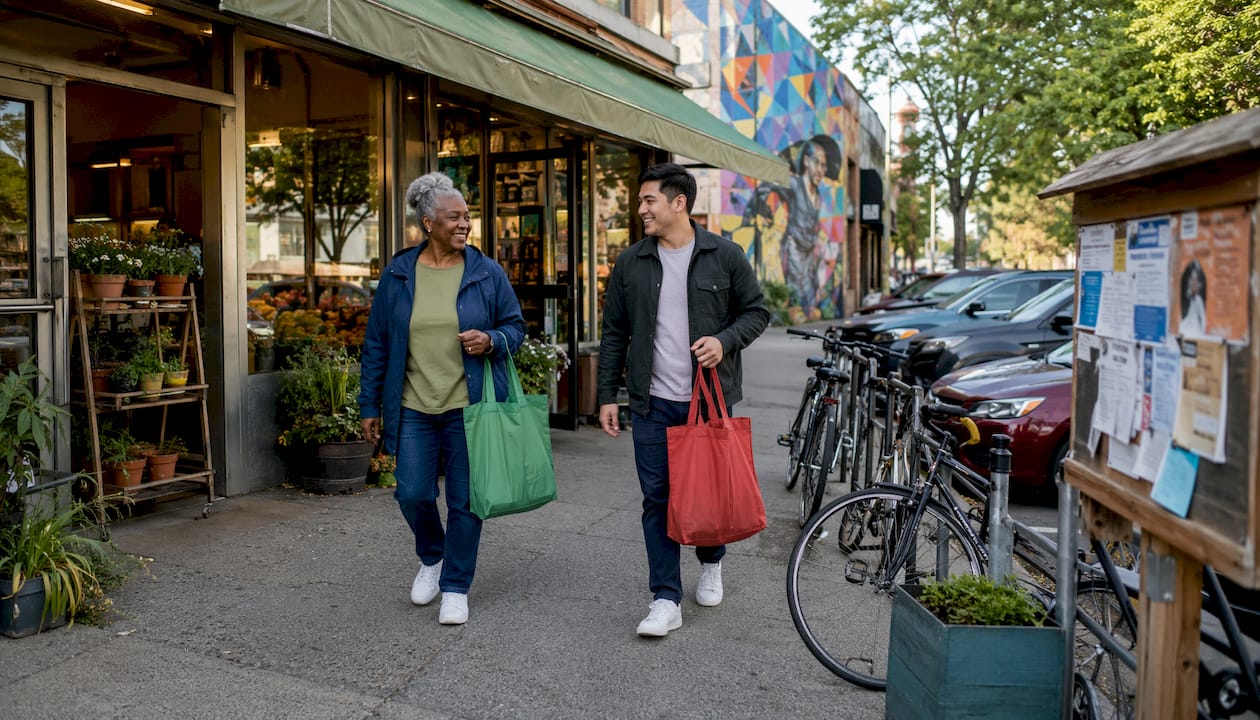
How researchers measure grocery access in suburban areas
Measuring suburban food accessibility requires more than drawing a circle on a map. Researchers and planners use several distinct approaches, each capturing a different dimension of the problem.
Distance and travel time measures are the most common starting point. The USDA defines low access as living more than one mile from a supermarket in urban areas and more than 10 miles in rural areas, but suburbs often fall awkwardly between those thresholds. A half-mile buffer may be appropriate in a dense suburb with sidewalks; it tells you almost nothing in a sprawling exurb where roads lack crosswalks.
Density and distribution metrics count the number of grocery stores per unit of population or land area within a defined zone. These measures reveal clustering, showing that some suburban corridors are oversupplied while adjacent neighborhoods go underserved.
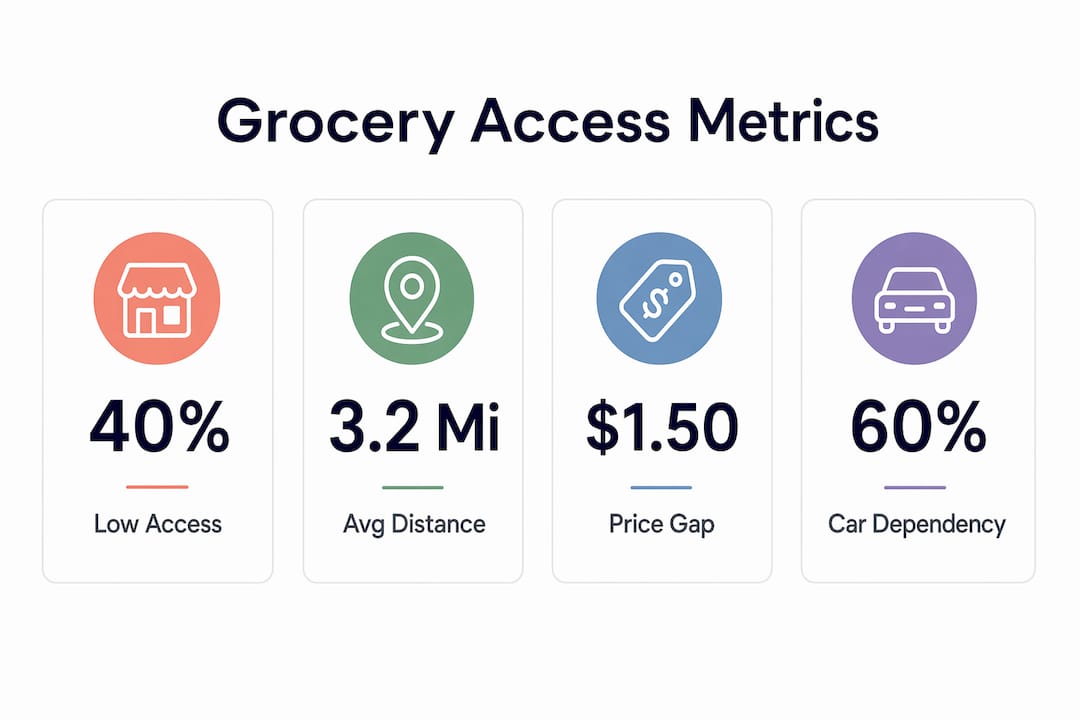
Economic access indicators account for price and affordability. Larger stores consistently offer more favorable prices for healthier food options, while smaller stores and convenience outlets tend to charge more for comparable items. Median household income in a store’s census tract is significantly associated with healthy food availability scores, meaning lower-income suburban neighborhoods face a double disadvantage: fewer large stores and less availability of healthy items in the stores that do exist.
Multidimensional indices combine distance, vehicle access, income, and transit infrastructure into composite scores. The USDA’s Food Access Research Atlas uses this approach, layering census data with store locations to identify low-access, low-income tracts.
| Measurement approach | What it captures | Key limitation |
|---|---|---|
| Distance to nearest store | Physical proximity | Ignores transportation mode and road safety |
| Store density per capita | Supply relative to population | Misses affordability and product range |
| Travel time by mode | Practical reachability | Data-intensive; varies by time of day |
| Economic access index | Price and income alignment | Requires store-level pricing data |
| Multidimensional composite | Combined spatial and socioeconomic factors | Complex to compute; varies by methodology |
The most policy-relevant insight from this body of measurement work is that proximity alone does not guarantee access. Households without vehicles who live more than 0.5 miles from the nearest supermarket or superstore are classified as access-burdened by the USDA, and their shopping patterns differ meaningfully from those with cars or closer stores. Access-burdened households are less likely to visit a large store, with a notably smaller share of access-burdened households reported shopping at a large grocery store during a survey week compared to households with sufficient access.
Transportation and infrastructure challenges that limit suburban grocery access
Car dependency is the defining feature of suburban food access barriers. Most suburban areas were built around the assumption that every household owns at least one vehicle, and the road networks, store placements, and land-use patterns reflect that assumption. For the roughly one in five suburban households without reliable vehicle access, the entire system works against them.

The problem is not simply that grocery stores are far away; understanding the benefits of eating local highlights how grocery store placement and accessibility can address suburban food deserts effectively. It is that the infrastructure between residents and stores is often hostile to any mode of travel other than driving. Dangerous road crossings, absent sidewalks, and missing transit stops create what researchers call an “infrastructure mismatch”: stores exist, but pedestrian and transit access is absent or unsafe. A resident living 0.8 miles from a supermarket may face a six-lane arterial road with no crosswalk standing between them and the store entrance.
Populations most affected by these barriers include:
- Elderly residents who have stopped driving but remain in suburban homes
- Low-income families who rely on public transit or rides from others
- People with disabilities for whom inaccessible infrastructure creates outright exclusion
- Recent immigrants who may lack licenses or vehicles and depend on walkable access
Public transit coverage in suburbs is typically sparse and infrequent. Bus routes designed for commuters heading downtown do not serve the lateral trips residents need to reach a grocery store in an adjacent commercial strip. Even where transit exists, the last quarter-mile from a bus stop to a store entrance may involve crossing a parking lot with no marked pedestrian path.
Community-led initiatives have emerged to fill these gaps. Residential chauffeur services, where volunteers or paid drivers take food-insecure residents to grocery stores on a scheduled basis, have proven effective in suburban settings. Cooperative retail models and mobile food pantries bring food directly into neighborhoods rather than requiring residents to travel. New supermarket developments, when sited thoughtfully, can also shift behavior: research from the UK found that new in-center or edge-of-center foodstores reduced car usage and increased walking for main food shopping trips among local residents.
Pro Tip: When planners evaluate a proposed grocery store site, pedestrian connectivity audits, not just traffic impact studies, should be required. A store that is only reachable by car serves only car owners.
Socioeconomic factors driving food insecurity in suburbs
Suburban poverty looks different from urban poverty, and that difference shapes how food insecurity manifests and how hard it is to address. The image of suburbs as middle-class and self-sufficient persists long after the demographic reality has shifted. Between 2018 and 2021, suburban poverty grew faster than urban poverty, yet the social infrastructure built to respond to food insecurity, food banks, pantries, SNAP outreach offices, remained concentrated in cities.
Suburban food insecurity is often hidden and stigmatized, resulting in lower participation in assistance programs and fewer local food support services compared to urban areas. Suburban food pantry users report less access to programming and greater stigma than their urban counterparts.
That stigma has measurable consequences. A 2010 Brookings Institution report found urban food stamp usage at 39.2% compared to 32% in suburbs, despite growing suburban need. The gap reflects not lower need but lower uptake, driven by social norms in communities where food assistance carries a stronger stigma than in urban neighborhoods with longer histories of public support programs.
Additional socioeconomic factors compounding suburban food insecurity:
- Dispersed geography makes it harder to site food pantries where they can serve the most people efficiently
- Lack of awareness about available programs, since suburban residents are less likely to encounter outreach through transit hubs or community centers
- Income volatility among suburban working families who earn too much to qualify for SNAP but too little to absorb a job loss or medical expense without cutting food spending
- Limited community garden access, with suburban zoning and lot configurations often restricting urban agriculture options that urban residents use to supplement food budgets
A case study from suburban Philadelphia illustrates the pattern. Food banks serving outer-ring suburbs report that many clients are first-time users who spent years unaware that services existed or too embarrassed to seek them. Outreach workers describe spending as much time reducing stigma as distributing food. The hidden nature of suburban food insecurity demands specialized engagement strategies, not just more pantry locations.
How grocery stores anchor suburban communities beyond food retail
A grocery store is rarely just a place to buy food. In suburban neighborhoods, it functions as one of the few remaining gathering points where residents from different backgrounds encounter each other regularly. That social dimension becomes visible only when the store disappears.
Store closures correlate with resident out-migration and increased food access barriers, particularly for elderly populations who depend on proximity. Property values in the surrounding blocks tend to decline after a grocery anchor closes, and nearby small retailers lose the foot traffic that kept them viable. The Iowa State University research on independent grocers documents this cascade clearly: a single store closure can trigger a broader commercial decline in a suburban strip or town center.
Grocery stores are essential social anchors that sustain community vitality and prevent neighborhood decline in suburbs. Their loss is rarely limited to the inconvenience of driving further for milk.
The positive effects of grocery store presence are equally concrete. Research on new foodstore openings found that 68% of shoppers combined grocery visits with trips to other shops or services in the surrounding retail center, generating linked-trip foot traffic that benefits restaurants, pharmacies, and service businesses nearby. New grocery openings also reduced the share of residents who left their local area entirely for food shopping, from 55.7% before opening to 25.4% afterward, a shift that keeps spending circulating locally.
Benefits of grocery stores as community anchors include:
- Providing employment, often the largest single employer in a suburban commercial district
- Generating foot traffic that sustains adjacent small businesses
- Serving as informal social infrastructure where neighbors interact
- Anchoring property values in surrounding residential blocks
- Offering a physical location for community health screenings, SNAP enrollment assistance, and nutrition education programs
The trade-off worth acknowledging is that new large grocery entries can reduce visits to nearby smaller food outlets. Grocery entry reduces traffic to convenience stores by about 3.1% within one mile, with effects varying by neighborhood demographics. For planners, that means the net community benefit of a new grocery anchor depends partly on what smaller retailers it displaces and whether those stores served populations the larger store will not.
What ethnic grocers and local convenience stores contribute to suburban food access
Ethnic grocery stores and neighborhood convenience stores fill gaps that large supermarkets structurally cannot. Their contribution to suburban food accessibility is both practical and cultural, and recent research has pushed back against the assumption that bigger always means better for food security outcomes.
Studies from Hartford, Connecticut found that smaller stores offered prices comparable to or lower than larger supermarkets for certain staple items, and produce quality in suburban smaller stores was often higher than expected. For immigrant and ethnic minority communities, the availability of culturally specific ingredients, from Caribbean root vegetables to South Asian spice blends, is not a luxury preference but a nutritional necessity. Families who cannot find familiar foods at a large chain store face real dietary disruption.
Key contributions of ethnic grocers and local convenience stores:
- Stocking culturally specific produce, proteins, and pantry staples unavailable at mainstream chains
- Operating in smaller footprints that fit into walkable suburban commercial strips
- Extending credit or flexible payment arrangements to regular customers in ways large chains cannot
- Providing multilingual staff who reduce language barriers to food access
- Serving as informal community hubs where cultural and social connections are maintained
- Identify gaps in large-chain coverage. Planners mapping food access should overlay demographic data with store inventories, not just store locations, to find neighborhoods where cultural food needs go unmet.
- Support small-format retail zoning. Suburban zoning that requires large parking lots and minimum lot sizes effectively excludes the small-format stores that serve dense or transit-oriented suburban nodes.
- Connect small retailers to SNAP authorization. Many ethnic grocers and convenience stores are not SNAP-authorized, limiting their utility for low-income shoppers. Streamlining the authorization process expands access without requiring new infrastructure.
- Leverage community-led models. Cooperative buying clubs and community-supported agriculture programs that partner with ethnic grocers have expanded food access in suburban New Jersey and suburban Maryland without requiring large capital investment.
Tojexpress, as a convenience store carrying American and Caribbean products, represents exactly this model: a neighborhood-scale retailer that meets specific cultural food needs in a suburban setting where large chains stock neither the products nor the cultural familiarity that many residents depend on. The role of local retail in sustaining community food access is most visible in the stores that serve populations the mainstream market overlooks.
Pro Tip: When assessing a suburban community’s food environment, include convenience stores and ethnic grocers in your store audit. Counting only supermarkets and superstores misses a substantial share of where residents actually shop.
How suburban grocery access has changed over time
The postwar suburban expansion of the 1950s and 1960s was built around the supermarket. Large-format grocery stores anchored new shopping centers, and car ownership was assumed to be universal. That model worked reasonably well for the demographics it was designed to serve: two-parent, car-owning, middle-income households.
The cracks appeared as suburbs diversified. By the 1980s and 1990s, consolidation in the grocery industry accelerated. Regional chains were absorbed by national ones, and smaller neighborhood stores closed as they could not compete on price with warehouse-scale retailers. Suburban commercial strips that once held independent grocers were replaced by big-box stores located on arterial roads, accessible primarily by car.
The 2000s brought a second wave of change. Suburban poverty grew, immigrant populations expanded into outer-ring suburbs, and the demographic mismatch between who lived in suburbs and what the food retail infrastructure offered became harder to ignore. Dollar stores proliferated in suburban commercial corridors, filling the retail vacuum left by grocery closures but offering limited fresh food. Food banks that had operated primarily in urban cores began opening suburban branches to meet demand they had not anticipated.
The COVID-19 pandemic accelerated several trends simultaneously. Online grocery ordering expanded rapidly, exposing both the potential and the limits of delivery-based access in suburbs. Supply chain disruptions hit smaller suburban stores harder than large chains with diversified suppliers. And the visibility of food insecurity in suburbs increased as middle-income families who had never used food assistance sought help for the first time.
Policies and interventions that improve suburban grocery access
The most effective interventions address the specific barriers that make suburban food access different from urban food access: car dependency, dispersed geography, stigma, and the mismatch between where stores are and where transit goes.
Financing and incentive programs have the longest track record. The Pennsylvania Fresh Food Financing Initiative, later replicated in other states, provided loans and grants to grocery operators willing to open in underserved areas. The USDA’s Community Facilities Direct Loan and Grant Program supports food retail in rural and suburban communities that lack adequate access. These programs work because they address the core problem: grocery operators face higher costs and lower projected sales in underserved suburban areas, and public subsidy can close that gap.
Zoning and land-use reform is increasingly recognized as a structural lever. Suburban zoning codes that require large parking minimums, prohibit mixed-use development, and set minimum lot sizes effectively exclude small-format grocery and ethnic food retailers. Reforming those codes to allow smaller footprints and reduce parking requirements can make neighborhood-scale food retail financially viable.
Transportation investments targeting food access specifically, rather than general commuter mobility, have shown results in pilot programs. Subsidized ride programs for grocery trips, expanded bus service to commercial corridors during evening and weekend hours, and safe pedestrian infrastructure connecting transit stops to store entrances all reduce the infrastructure mismatch that limits practical access.
SNAP outreach and enrollment support in suburban settings requires different tactics than urban outreach. Door-to-door canvassing, partnerships with suburban school districts, and enrollment assistance at suburban food pantries have increased participation rates in communities where awareness and stigma have historically suppressed uptake.
Community gardens and urban agriculture programs, while not a substitute for grocery access, supplement food budgets and build community capacity. Suburban municipalities that have reformed zoning to permit front-yard gardens and community plots have seen measurable increases in fresh produce consumption among participating households.
How suburban grocery access compares to urban and rural access
Suburbs occupy an awkward middle position in food access research. Urban food deserts get the most policy attention, and rural food access has a well-developed literature focused on distance and sparse retail. Suburban food insecurity tends to fall between those frameworks, misclassified or overlooked by tools calibrated for denser or sparser environments.
Urban areas typically have higher store density, better transit connectivity, and more established food assistance infrastructure. The challenges in cities center on affordability and neighborhood-level disparities in store quality, not on whether a store exists within reach. Rural areas face the opposite problem: stores are genuinely scarce, distances are long, and vehicle access is the only practical option for most residents.
Suburbs combine elements of both without fitting either model cleanly. Store density is generally higher than rural areas but lower than urban cores. Transit is better than rural areas but far worse than cities. Income diversity is wider than either extreme, with affluent and low-income households sometimes sharing the same zip code but with very different practical access to food.
The food desert concept, developed primarily for urban contexts, is insufficient for suburbs because suburban access issues are less about the presence of stores and more about the infrastructure connecting residents to them. A suburban census tract may not qualify as a food desert by USDA criteria while still containing thousands of residents who cannot practically reach the nearest supermarket without a car. Planners and researchers working in suburban contexts need metrics that capture transportation mode, pedestrian infrastructure quality, and demographic vulnerability, not just store proximity.
How online grocery shopping and delivery services affect suburban access
Online grocery ordering and home delivery have expanded rapidly, and suburbs are often cited as the natural market for these services: residents have addresses, many have internet access, and delivery logistics are simpler than in dense urban cores. The reality is more complicated.
Delivery services tend to concentrate in higher-income suburban zip codes where order volumes justify the logistics cost. Lower-income suburban areas, particularly those with higher rates of food insecurity, often fall outside delivery zones or face minimum order requirements that exclude households buying small quantities. Residents without credit or debit cards, or without reliable internet access, cannot use these platforms at all.
For households with sufficient income and connectivity, online ordering does meaningfully expand access. It removes the transportation barrier entirely for those who can afford delivery fees, and subscription-based models like grocery pickup programs reduce costs for regular users. The food accessibility benefits are real but unevenly distributed.
SNAP online purchasing, authorized by the USDA and expanded during the pandemic, has extended some of these benefits to lower-income suburban households. As of 2026, most major grocery retailers accept SNAP for online orders in most states, though pickup is more widely available than delivery for SNAP transactions. That distinction matters in suburbs where driving to a pickup location is feasible for some households but not for those without vehicles.
The deeper limitation of delivery-based solutions is that they address individual household access without strengthening the community food infrastructure that sustains neighborhoods over time. A suburb where residents order groceries online but no physical store remains open loses the community anchor function, the employment, the foot traffic, the social gathering space, that a store provides. Online access and physical retail access solve different problems, and policy frameworks that treat them as substitutes miss that distinction.
Key Takeaways
Suburban grocery access shapes food security, community health, and neighborhood vitality in ways that standard food desert metrics consistently undercount.
| Point | Details |
|---|---|
| Proximity does not equal access | Access-burdened households are less likely to shop at large stores compared to those with sufficient access. |
| Suburban poverty is growing | Between 2000 and 2013, low-income suburban populations grew substantially faster than in primary cities, driving rising food insecurity. |
| Infrastructure mismatch is the core barrier | Car-dependent design and absent pedestrian infrastructure, not store scarcity, are the primary limits on practical suburban grocery access. |
| Stigma suppresses assistance uptake | Urban food stamp usage reached 39.2% versus 32% in suburbs despite growing suburban need, reflecting stigma and awareness gaps. |
| Small and ethnic stores fill critical gaps | Smaller stores in Hartford, CT offered comparable or lower prices on staples and higher produce quality, serving cultural needs large chains cannot meet. |