

How food accessibility shapes Atlanta's communities
TOJEXPRESS.COM-Antonio HenryTL;DR:
- Over a quarter of Atlanta’s low-income residents live more than a mile from a supermarket.
- Food access involves proximity, affordability, availability, and cultural relevance.
- City initiatives are working to improve food access through community-driven projects and innovative programs.
More than one in four Atlantans live in census tracts where low-income residents live over a mile from a supermarket. That number is easy to scroll past, but for families in southwest Atlanta, it means choosing between a long bus ride for fresh vegetables or picking up whatever is available nearby. Food accessibility isn’t just a policy term. It shapes daily decisions, health outcomes, and whether a community feels seen or ignored. This guide walks through what food accessibility really means, why Atlanta’s situation is more layered than most people realize, and what’s actually being done to close the gap.
Table of Contents
- Understanding food accessibility: Definitions and Atlanta’s reality
- Barriers to food access: Proximity, price, transit, and equity
- Cultural fit and diversity in food choices
- Solutions and innovations: What’s working in Atlanta?
- Why true food accessibility is about more than geography
- Enhancing your food journey in Atlanta
- Frequently asked questions
Key Takeaways
| Point | Details |
|---|---|
| Access is multi-layered | Food accessibility in Atlanta involves geography, affordability, transit, and cultural relevance. |
| Equity gaps persist | Majority-Black and low-income neighborhoods face the greatest barriers to healthy food options. |
| Local solutions matter | Community-driven markets and partnerships play a vital role in improving real access. |
| Cultural food options | Access must include culturally relevant foods for diverse communities, not just proximity. |
Understanding food accessibility: Definitions and Atlanta’s reality
Food accessibility means more than having a grocery store somewhere in your zip code. It covers three things: proximity (how far you have to travel), affordability (whether you can pay for what’s there), and availability (whether what’s there meets your needs). When any one of these breaks down, access breaks down.
Two terms come up constantly in this conversation and they are not the same thing. A food desert is an area where low-income households live far from a supermarket, typically more than one mile in urban areas. A food swamp is an area flooded with fast food and convenience options but short on healthy, nutritious choices. Atlanta has pockets of both, sometimes overlapping in the same block.
The USDA Food Access Research Atlas tracks low-income, low-access census tracts across the country, and Atlanta shows up in a troubling number of them. But the federal data only tells part of the story. Neighborhood-level breakdowns reveal a sharper picture.
| Indicator | Majority-Black neighborhoods | Non-majority-Black neighborhoods |
|---|---|---|
| Stores with fresh produce | 36% | 61% |
| Low-income, low-access tracts | Higher concentration | Lower concentration |
| Transit access to grocery stores | More limited | More available |
A 2023 Emory University study found only 36% of stores in majority-Black Atlanta neighborhoods offered fresh produce, compared to 61% in non-majority-Black areas. That gap isn’t accidental. It reflects decades of disinvestment, redlining, and retail decisions driven by profit over community need.
Here’s what that looks like in practice:
- Residents in lower-income neighborhoods often rely on corner stores that stock processed foods
- Dollar stores have filled gaps left by supermarket closures but rarely carry produce
- Families without cars face compounded barriers: distance plus transit unreliability
- Even when stores exist, prices may be higher due to less competition
“Access is not just about whether a store exists. It’s about whether that store serves you.”
Understanding these distinctions matters because solutions that only count stores per square mile miss half the problem. Neighborhood stores boost food access in ways that policy maps rarely capture, especially when they stock culturally relevant products.
Barriers to food access: Proximity, price, transit, and equity
Knowing what food accessibility means is one thing. Living with its barriers is another. Let’s dig into the specific obstacles Atlanta residents face every day.
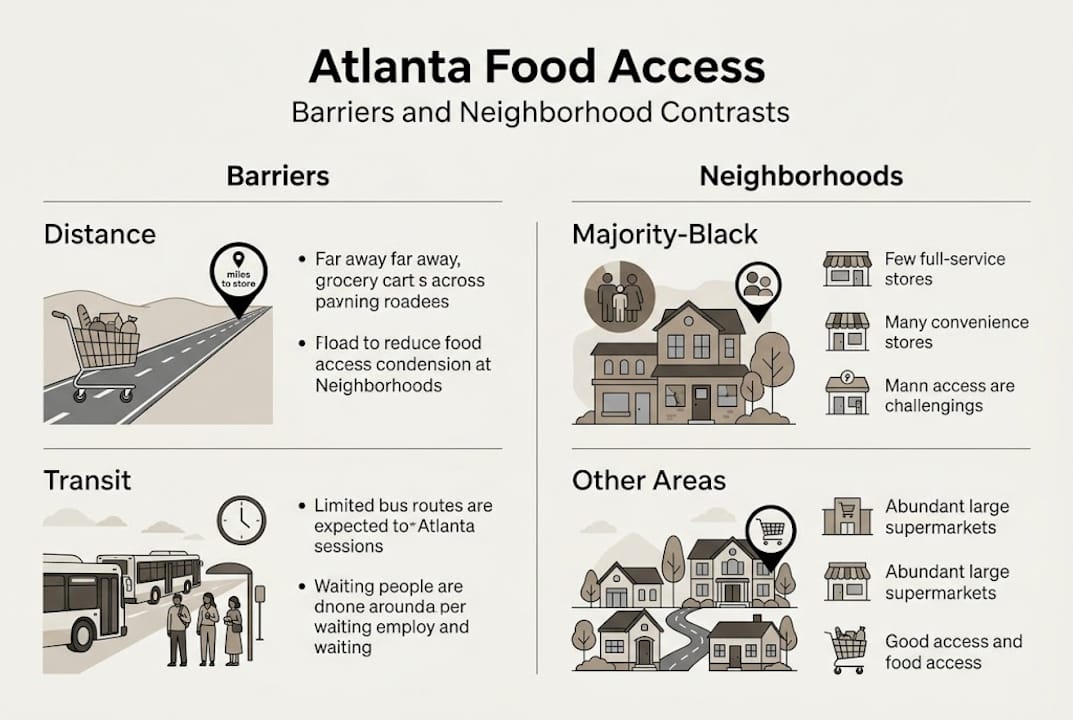
1. Physical proximity. The one-mile standard used by the USDA sounds manageable until you are carrying groceries in summer heat or managing young children. In practice, one mile can feel like five. Neighborhoods that lost supermarkets to closures over the past two decades have never fully recovered that access.
2. Affordability. Stores in lower-income areas often charge more for comparable products because they operate with less competition. Fresh produce at a corner store may cost significantly more than the same item at a big-box retailer in a wealthier suburb. That price gap adds up fast for families on fixed incomes.
3. Transportation. This is where equity becomes undeniable. Public transit access to grocery stores is 70% higher for White populations than Black populations in Atlanta. That statistic deserves a moment of pause. It means transit routes, which many residents depend on entirely, are designed in ways that leave Black communities further from food sources.
4. Time as a barrier. Working multiple jobs or caring for family members limits how far or how long someone can shop. Even if a transit route technically reaches a supermarket, a two-hour round trip for groceries is not realistic for most people.
Pro Tip: Online transit maps often show routes that exist on paper but run infrequently or skip key stops. Always check actual schedules and transfer times before assuming a store is reachable.
Here’s how these barriers interact for a typical resident:
- The nearest full supermarket is 1.5 miles away
- No car means relying on a bus that runs every 40 minutes
- Round trip with transfers takes 90 minutes minimum
- Prices are still higher there than at suburban stores
- Culturally relevant items are stocked inconsistently or not at all
| Barrier | Impact | Who it hits hardest |
|---|---|---|
| Distance | Limits options | Car-free households |
| Price | Reduces purchasing power | Low-income families |
| Transit gaps | Adds time and cost | Black and brown communities |
| Limited variety | Cultural exclusion | Immigrant and diaspora communities |
The role of grocery stores goes beyond just food. They anchor neighborhoods and signal investment. When they leave, the whole community feels it. Metro Atlanta convenience stores have stepped in to fill some of these gaps, but they work best when they stock what residents actually need.
Cultural fit and diversity in food choices
Food access isn’t just physical. It’s also cultural. A store can be two blocks away and still not serve you if it doesn’t carry the ingredients your family actually cooks with.
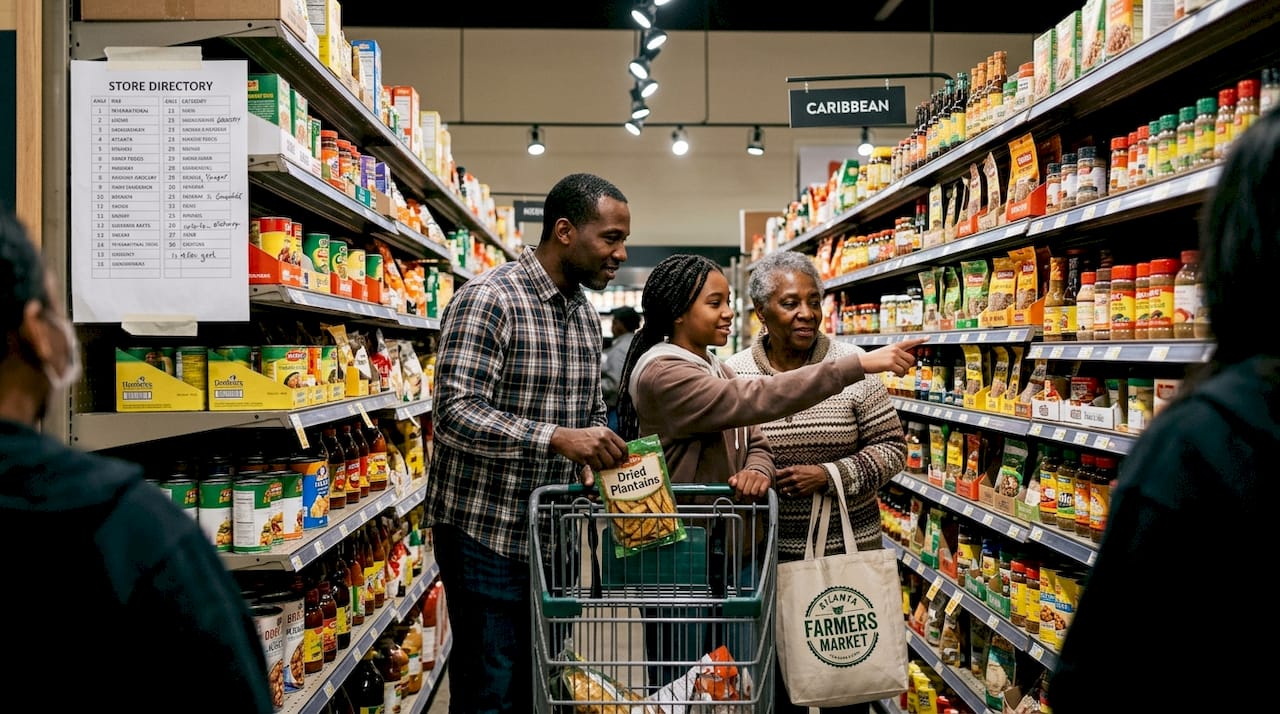
For Atlanta’s Caribbean and broader diaspora communities, this gap is felt daily. Mainstream supermarkets in Black neighborhoods stock fewer healthy or culturally appropriate items, and Caribbean imports are often missing entirely. That means residents must travel further, to specialty shops or international markets, to find the foods that are central to their cooking traditions.
Here’s what cultural gaps typically look like for these communities:
- Plantains, yuca, and breadfruit rarely stocked in mainstream chains
- Authentic jerk seasoning and Scotch bonnet peppers hard to find locally
- Caribbean-style dried goods and canned products often unavailable
- American Southern staples like smoked meats and specific cuts inconsistently stocked
- Imported beverages and condiments require specialty trips
When a store only carries “healthy” options defined by mainstream American standards, it erases the nutritional value of culturally distinct foods. Callaloo, ackee, and saltfish are not exotic additions. They are dietary staples for millions of people.
Pro Tip: Ethnic neighborhood markets and specialty stores often carry a wider range of authentic Caribbean and international products at competitive prices. They’re worth the search, and supporting them keeps those options available in your community.
Shopping journeys for culturally specific items usually involve multiple stops. Someone might buy produce at a mainstream supermarket, then travel to a separate Caribbean market for dried goods and spices. That extra trip costs time, money, and energy. Caribbean cuisine’s role in Atlanta’s food culture is growing, but the infrastructure to support it hasn’t kept pace.
This is why international foods enhance Atlanta’s diversity in ways that go beyond novelty. They represent real community needs. And specialty stores in Atlanta that stock these items are doing essential equity work, not just serving a niche market.
Solutions and innovations: What’s working in Atlanta?
The challenges are real. But so are the responses. Atlanta has seen a growing number of public, private, and community-driven efforts to close the food access gap.
City of Atlanta initiatives like Azalea Fresh Market and Goodr use public-private partnerships and grants to address food deserts in under-served neighborhoods. These aren’t just symbolic gestures. They represent actual capital being directed at communities that have been passed over by traditional retail investment.
Here’s a breakdown of what’s working:
- Azalea Fresh Market: A city-backed grocery concept targeting neighborhoods with no nearby supermarket
- Goodr: A tech-enabled food rescue and redistribution platform reducing waste while improving access
- Mobile markets: Pop-up produce trucks that bring fresh food into transit-limited areas
- SNAP incentive programs: Doubling benefits at farmers markets and local grocers to increase purchasing power
- Community fridges: Neighborhood-maintained free food resources operating outside formal retail
| Strategy | Strength | Limitation |
|---|---|---|
| New grocery stores | Direct, physical access | Risk of spurring gentrification |
| Mobile markets | Flexible, community-centered | Inconsistent availability |
| Food rescue programs | Reduces waste, increases supply | Depends on donation surplus |
| Transit improvements | Multiplies access broadly | Slow to implement |
“New stores can help and hurt at the same time, improving access while making the neighborhood less affordable for the people it was meant to serve.”
Critics point out that equity-focused stores can be double-edged, helping current residents but also potentially spurring gentrification that prices them out over time. That tension doesn’t mean the stores are a bad idea. It means community input and affordable housing policy must be part of the same conversation.
The most durable solutions tend to be community-rooted. When residents are involved in planning, when stores stock what local families actually eat, and when neighborhood food access programs are built with rather than for communities, the results last longer.
Why true food accessibility is about more than geography
Here’s something most food policy discussions still get wrong: they treat access as a mapping problem. Draw a circle around a census tract, count stores within the radius, and declare progress or failure. That framing misses most of what actually blocks people from eating well.
The biggest obstacles aren’t always distance. They’re price points that don’t match neighborhood incomes. They’re stores that stock shelf after shelf of products that have nothing to do with how a community cooks. They’re transit systems that were never designed with food equity in mind.
Top-down solutions that drop a new supermarket into a neighborhood and call it done tend to underperform. Communities already know what they need. The question is whether anyone is listening. Lasting food access means centering the actual diversity in Atlanta’s food scene, including Caribbean, African, and Southern American traditions, not just adding more square footage of the same national brands.
If you want to understand what food access really means in a neighborhood, talk to the people who shop there. Their daily decisions reveal more than any federal atlas.
Enhancing your food journey in Atlanta
If you’ve read this far, you already care more about food accessibility than most. And that matters. Real change in Atlanta’s food landscape starts with residents, shoppers, and community members making intentional choices about where they buy and what they support.
At TOJ EXPRESS, we stock American and Caribbean products because we know that access means nothing if the shelves don’t reflect your actual food culture. From authentic Caribbean staples to everyday American goods, we’re here to bridge the gap between what’s available and what your family actually needs. Explore Caribbean food options and see how a community-focused store can make a real difference in your daily food journey.
Frequently asked questions
What is a food desert, and how does it affect Atlanta?
A food desert is an area where residents face limited access to affordable and nutritious food. In Atlanta, over one in four low-income residents live more than a mile from a supermarket, making daily food choices a significant challenge.
Why do cultural food options matter when discussing food accessibility?
Cultural food options ensure communities can access ingredients that match their heritage and dietary needs. When stores omit culturally relevant items like Caribbean imports, residents face an additional layer of exclusion beyond just physical distance.
How are Atlanta city initiatives addressing food deserts?
Programs like Azalea Fresh Market and Goodr use public-private partnerships and grant funding to bring healthy food options into under-served Atlanta neighborhoods that traditional retail has long ignored.
Are there differences in food access between Atlanta’s neighborhoods?
Yes, significantly. Majority-Black neighborhoods are less likely to have stores with fresh produce, with only 36% stocking it compared to 61% in other areas, and they face larger transportation barriers as well.