

The Role of Food in Caribbean Diaspora Identity
TOJEXPRESS.COM-Antonio HenryTL;DR:
- Caribbean food serves as a vital means of transmitting cultural memory, identity, and community across borders. It encodes layered historical influences and is maintained through adaptation, sensory learning, and community events. Food fosters cultural resilience by linking diaspora members to their heritage and shaping their collective identity.
Food is the primary medium through which Caribbean diaspora communities carry memory, transmit culture, and sustain identity across generations and borders. When a Trinidadian grandmother in Brooklyn makes pelau on a Sunday, she is not just cooking. She is performing an act of cultural continuity that no classroom can replicate. The role of food in Caribbean diaspora life extends far beyond nutrition. It encodes migration histories, preserves ancestral knowledge, and gives diaspora members a living connection to homelands they may have never visited. Understanding this connection means understanding how Caribbean culinary traditions function as both personal memory and collective heritage.
What is the role of food in Caribbean diaspora communities?
Food in the Caribbean diaspora is defined as a cultural practice that carries memory, identity, and community bonds across geographic displacement. Scholars and cultural practitioners recognize food as one of the most durable forms of heritage transmission available to migrant communities. Unlike language, which can fade within two generations, food rituals tend to persist because they engage the body directly. The smell of scotch bonnet peppers, the sound of a mortar grinding spices, the texture of roti pulled apart by hand. These sensory anchors connect diaspora members to places and people across time.
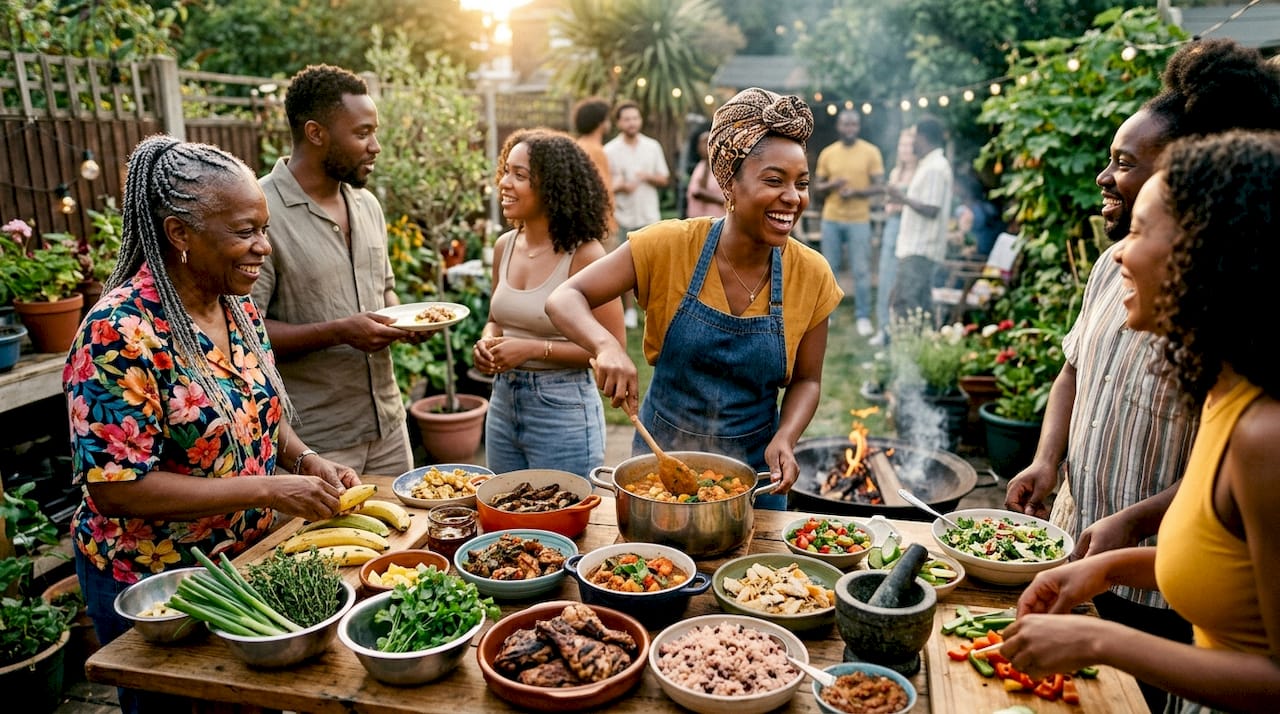
The cultural significance of Caribbean food lies in its layered meanings. A single dish can reference colonial history, African survival strategies, indentured labor, and family love simultaneously. That density of meaning is what makes food such a powerful vehicle for identity. Diaspora members who cook traditional dishes are not simply satisfying hunger. They are affirming who they are and where they come from.
What historical influences shape Caribbean cuisine?
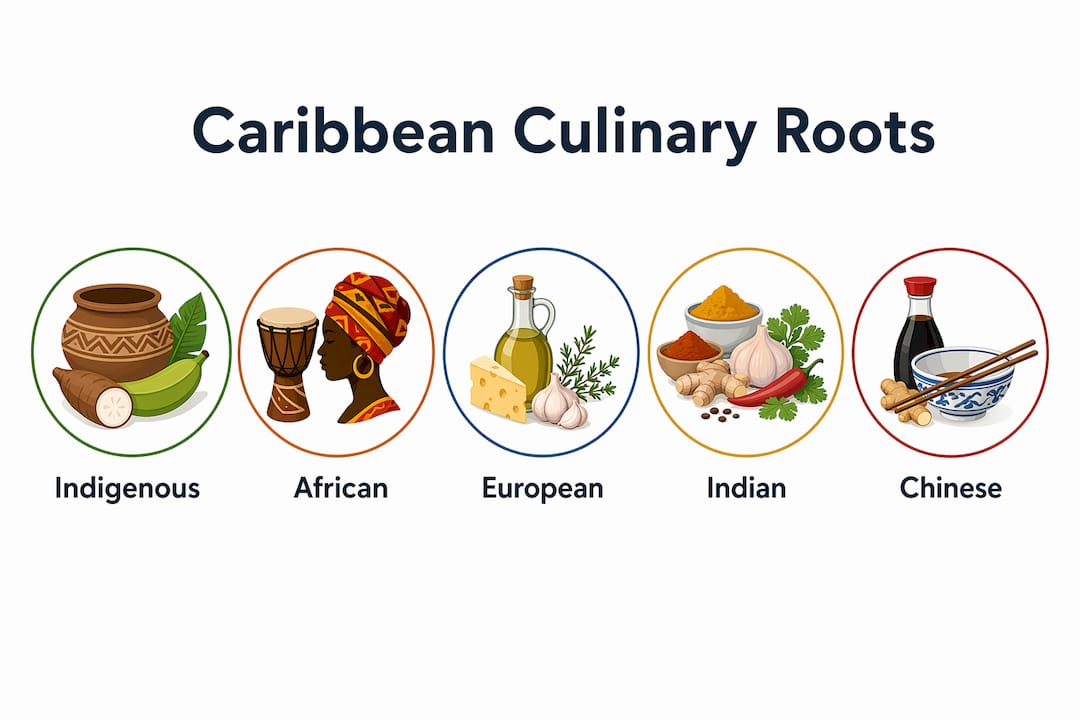
Caribbean cuisine blends five culinary traditions: Indigenous, West African, European, Indian, and Chinese. Each tradition arrived through distinct historical circumstances, and each left permanent marks on the food that diaspora communities now carry abroad. Understanding these roots reveals why Caribbean food is so complex and why no single dish tells the whole story.
The five foundational influences break down this way:
- Indigenous traditions contributed root vegetables like cassava and sweet potato, along with techniques such as smoking and pepper-based seasoning that predate European contact.
- West African traditions brought okra, plantain, black-eyed peas, and the culinary logic of slow cooking and communal preparation. Stewing and communal cooking trace directly to African culinary memory preserved through enslavement.
- European colonial influence introduced salt fish, breadfruit, and the plantation economy’s reliance on preserved foods, which shaped the flavor profiles of dishes still eaten today.
- Indian traditions arrived through indentured labor. Approximately 147,500 Indian laborers were brought to Trinidad between 1845 and 1917. Their culinary legacy produced roti, doubles, and curry dishes that are now central to Trinidadian identity and New York City’s Caribbean street food scene.
- Chinese traditions contributed techniques like stir-frying and ingredients like five-spice, which blended into local cooking in Trinidad, Jamaica, and Guyana.
This hybrid identity is not a dilution of any single tradition. It is a new culinary language forged from historical pressure and human creativity. Diaspora communities inherit this entire layered history every time they cook.
Pro Tip: When you research a Caribbean dish’s origins, trace each ingredient separately. You will often find that one plate holds five centuries of migration history.
How do diaspora communities adapt traditional foods abroad?
Adaptation is not compromise. Caribbean diaspora cooks have always worked with what is available, and that practice has deep historical roots. Scarcity shaped Caribbean cooking from the beginning. Plantation-era cooks prioritized technique over exact ingredients because exact ingredients were rarely guaranteed. That same logic travels with diaspora communities to London, Toronto, New York, and Atlanta.
Common adaptations diaspora cooks make include:
- Substituting scotch bonnet peppers with habaneros when Caribbean varieties are unavailable
- Using store-bought coconut milk instead of freshly grated coconut
- Replacing fresh thyme with dried thyme in rice and peas
- Swapping local greens for callaloo when dasheen leaves are out of season
- Adjusting slow-cook times to fit apartment kitchens without outdoor fire pits
Each substitution carries a decision: how close can I get to the original taste, and what does “original” even mean when the dish itself was born from substitution? The answer Caribbean cooks have always given is that technique and intention matter more than ingredient perfection. A pot of oxtail stew made with care in a Bronx apartment is as authentic as one made in Kingston, because authenticity lives in the method and the meaning, not just the market list.
Pro Tip: Keep a small notebook of your substitutions and results. Over time, you build a personal diaspora cookbook that documents your own culinary adaptation history.
The food identity in Caribbean communities abroad also shifts through community events. Caribbean food festivals and community cookouts facilitate intergenerational exchange that no single kitchen can provide. These gatherings let younger generations taste dishes they have never made and ask questions they would not think to ask at home.
How does food transmit culture to Caribbean diaspora youth?
Food teaches what textbooks cannot. When a child watches a parent debone salt fish, they learn patience, economy, and the history of why preserved fish became a staple. The importance of food in diaspora communities is clearest in how it functions as a classroom without walls.
Caribbean culinary heritage is primarily transmitted through sensory and oral apprenticeship rather than formal recipes. Success in diaspora cooking depends on replicating scents, sounds, and textures. The aroma of sautéed aromatics, the rhythm of stirring, the sound of oil hitting a hot pan. These sensory cues link directly to memory and identity in ways that written instructions cannot capture.
The “Recipes for Resilience” project, active during 2021 and 2022, used digital storytelling and oral histories to connect younger Caribbean diaspora members with ancestral food heritage. The project recognized that food knowledge was disappearing not because people stopped caring, but because the transmission method had no formal structure. By recording elders cooking and narrating, the project created a living archive of technique, memory, and cultural meaning.
The table below shows how food functions across different dimensions of diaspora youth identity:
| Function | How food delivers it |
|---|---|
| Geographic knowledge | Dishes teach island names, regions, and landscapes through ingredient origins |
| Historical awareness | Recipes carry references to colonial trade, migration, and survival strategies |
| Language preservation | Food names and cooking terms maintain Creole and patois vocabulary |
| Community belonging | Shared meals at family and cultural events reinforce group identity |
| Personal pride | Mastering a traditional dish builds confidence and cultural ownership |
The role of recipes in diaspora communities goes beyond instruction. A recipe passed down from a grandmother is also a biography, a geography lesson, and a declaration of cultural survival.
How does Caribbean food reclaim cultural narratives in the diaspora?
Caribbean food in mainstream spaces often gets reduced to “exotic” or “tropical,” stripping away the complexity that makes it meaningful. Diaspora creators, chefs, and writers push back against this reduction consistently and deliberately.
Key ways diaspora food practitioners reclaim their culinary narratives include:
- Writing cookbooks that center history and migration alongside recipes
- Running pop-up restaurants that explain dish origins to non-Caribbean guests
- Using social media to document traditional techniques before they disappear
- Challenging restaurant menus that flatten island-specific differences into a generic “Caribbean” category
Caribbean cuisine is rich, contradictory, and unrefined. Current movements work to restore ownership of these narratives, asserting that the food is not a backdrop for tourism but a living record of survival and creativity.
The cultural significance of Caribbean food is precisely its refusal to be simple. There is no singular Caribbean flavor. Each island carries distinct spice levels, techniques, and ingredients shaped by its own history. Jamaican jerk seasoning is not the same as Barbadian seasoning. Haitian griot is not the same as Puerto Rican pernil. When diaspora cooks insist on these distinctions, they are doing cultural work. They are refusing to let their heritage be collapsed into a single, marketable identity.
The effort to replicate traditional dishes abroad also reveals something deeper. Replicating traditional Caribbean dishes in a new country is a concrete act of cultural grounding. It says: I know where I come from, and I will not let that knowledge disappear.
Key Takeaways
Food in the Caribbean diaspora functions as the primary medium for transmitting cultural identity, historical memory, and community belonging across generations and geographies.
| Point | Details |
|---|---|
| Food carries layered history | Caribbean dishes encode Indigenous, African, European, Indian, and Chinese culinary traditions simultaneously. |
| Adaptation preserves authenticity | Ingredient substitutions continue a historic Caribbean tradition of resilience, not a departure from it. |
| Sensory learning transmits heritage | Smell, sound, and texture teach diaspora youth what written recipes cannot capture. |
| Food resists cultural reduction | Diaspora cooks actively reclaim the complexity of Caribbean cuisine against mainstream oversimplification. |
| Community events reinforce identity | Festivals and cookouts create intergenerational spaces for cultural exchange and shared memory. |
Why food will always be the heart of Caribbean diaspora life
I have watched people tear up over a bowl of soup. Not because the soup was extraordinary by any restaurant standard, but because it tasted exactly like their mother’s kitchen in Port of Spain or their grandmother’s yard in St. Elizabeth. That reaction tells you everything about what food actually does in diaspora life. It collapses distance. It makes the absent present.
What I find most striking is how little credit diaspora cooks get for the intellectual and emotional labor they perform. Recreating a dish in a foreign country without the right ingredients, without the right climate, sometimes without anyone to ask, is a genuine act of cultural scholarship. You are reverse-engineering a sensory memory using incomplete information. The fact that it works, that the dish comes out recognizable and right, is remarkable.
The conventional wisdom says that food traditions fade with each generation. My experience says the opposite. When young Caribbean Americans and Caribbeans in the UK start cooking their grandparents’ dishes, they often become more deliberate about it than the generation before them. They document. They ask questions. They treat the kitchen as a research site. The essential Caribbean spices that older generations used without thinking become objects of study and pride for younger cooks.
Food is not a passive inheritance. It is an active practice. Every time you cook a traditional dish, you make a choice to keep something alive. That choice matters more than any museum exhibit or cultural festival ever could.
— ANTONIO
Tojexpress and authentic Caribbean cooking abroad
Cooking Caribbean food authentically outside the Caribbean starts with having the right ingredients. That is a real challenge for diaspora cooks who know exactly what a dish should taste like but cannot always find what they need locally.

Tojexpress stocks authentic Caribbean products alongside American staples, giving diaspora cooks access to the spices, seasonings, and specialty items that make traditional dishes taste right. From scotch bonnet-based sauces to island-specific spice blends, Tojexpress carries the ingredients that connect a kitchen in Atlanta or New York to the Caribbean. You can browse the full Caribbean product selection and find what your recipes actually call for, not the closest substitute. For cooks who want to go deeper, the Caribbean spice preparation guide walks through techniques that make a real difference in the final dish.
FAQ
What is the role of food in Caribbean diaspora identity?
Food is the primary medium for carrying cultural memory, migration history, and community identity in Caribbean diaspora communities. It transmits values and heritage across generations through cooking, sharing meals, and sensory learning.
How do Caribbean diaspora communities keep food traditions alive?
Caribbean diaspora communities maintain food traditions through sensory and oral apprenticeship, community festivals, digital storytelling projects like “Recipes for Resilience,” and deliberate ingredient sourcing to replicate traditional dishes abroad.
Why is Caribbean cuisine considered a hybrid culinary tradition?
Caribbean cuisine blends five foundational traditions: Indigenous, West African, European, Indian, and Chinese. Each arrived through distinct historical circumstances including colonization, enslavement, and indentured labor, creating a layered culinary identity unique to the region.
Does adapting Caribbean recipes abroad make them less authentic?
Adaptation does not reduce authenticity. Caribbean cooking has always prioritized technique and intention over exact ingredients, a tradition rooted in historical scarcity. Diaspora substitutions continue that same practice of resilience.
How does food help Caribbean diaspora youth connect to their heritage?
Food teaches geography, history, and cultural values through direct sensory experience. Projects like “Recipes for Resilience” use oral histories and cooking demonstrations to give younger generations access to ancestral knowledge that written recipes alone cannot convey.