

Caribbean food pantry checklist for authentic island cooking
TOJEXPRESS.COM-Antonio HenryTL;DR:
- A well-stocked Caribbean pantry relies on authentic ingredients with long shelf lives, versatility, and strong flavor impacts. Proper storage, regular replacement, and strategic freezing help maintain freshness, ensuring flavorful, authentic dishes. Shopping online or at local markets makes accessing these essentials convenient for home cooks everywhere.
Walking into a Caribbean kitchen with a half-stocked pantry is like trying to play calypso with half the instruments missing. The right ingredients are not optional extras — they are the entire foundation. A solid caribbean food pantry checklist saves you from last-minute grocery runs, keeps meals budget-friendly, and most importantly, ensures every pot tastes the way it should. Whether you are cooking pelau for Sunday dinner or whipping up a quick curry channa on a weeknight, this guide walks you through every category of Caribbean pantry essentials, from grains to green seasoning, with storage tips that make it all last.
Table of Contents
- Key criteria for building an authentic Caribbean pantry
- Essential staples: grains, legumes, and ground provisions
- Herbs and aromatics: building the flavor foundation
- Spices and seasoning blends: flavor pillars of Caribbean cooking
- Comparing pantry essentials: how to blend and use for diverse Caribbean dishes
- The overlooked essentials and insider tips for your Caribbean pantry
- Where to shop for authentic Caribbean pantry staples in Atlanta
- Frequently asked questions
Key Takeaways
| Point | Details |
|---|---|
| Pantry essentials criteria | Choose ingredients with long shelf life, versatility, and authentic flavor impact for your Caribbean kitchen. |
| Core pantry staples | Stock grains like rice and legumes, fresh herbs, aromatics, and essential spices for classic dishes. |
| Proper storage matters | Keep spices and dry goods airtight and away from light and moisture to preserve potency. |
| Fresh herbs and seasoning | Use fresh herbs and green seasoning blends to build deep Caribbean flavors layer by layer. |
| Replace ground spices regularly | Swap ground spices every six months to avoid flat, dull flavors in your cooking. |
Key criteria for building an authentic Caribbean pantry
Before you start loading your cart, you need a framework. Not every ingredient deserves a permanent spot on your shelf. The best Caribbean food pantry checklist is built around four non-negotiable criteria: authenticity, shelf life, versatility, and flavor impact.
Authenticity means the ingredient actually appears in traditional island cooking, not a supermarket substitute. Chadon beni, for example, is not the same as flat-leaf parsley, even though both are green and leafy. Flavor-wise, they live in completely different worlds.
Shelf life is equally critical. Pantry staples stored airtight can last 6 to 12 months and stretch meals for one-pot dishes with zero waste. That matters when you are storing Caribbean ingredients in an Atlanta home where summer heat and humidity can destroy an improperly stored spice within weeks.
Versatility separates the true essentials from the nice-to-haves. Coconut milk, for instance, works in rice and peas, stews, curries, and even desserts. One can does a lot of work.
Flavor layering means the ingredient contributes something unique: heat, earthiness, freshness, or body. Here is a quick screening checklist before any item earns a shelf spot:
- Does it appear in at least three traditional Caribbean dishes?
- Does it last at least 3 months with proper storage?
- Does it add a flavor you cannot replicate with something else?
- Is it available at a Caribbean grocer or online?
If an ingredient passes three out of four, it belongs on your grocery list for Caribbean dishes.
Essential staples: grains, legumes, and ground provisions
These are the workhorses. When the fridge is empty, your grains and legumes are what stand between you and a meal. Stocking 5 to 7 legumes and grains — rice, split peas, lentils, black-eyed peas, flour, and cornmeal — stretches meals and makes one-pot cooking genuinely effortless.
Rice is the backbone. Long-grain white rice works for everyday pelau and rice and peas. Parboiled rice holds up better in stews without going mushy. Keep both on hand.
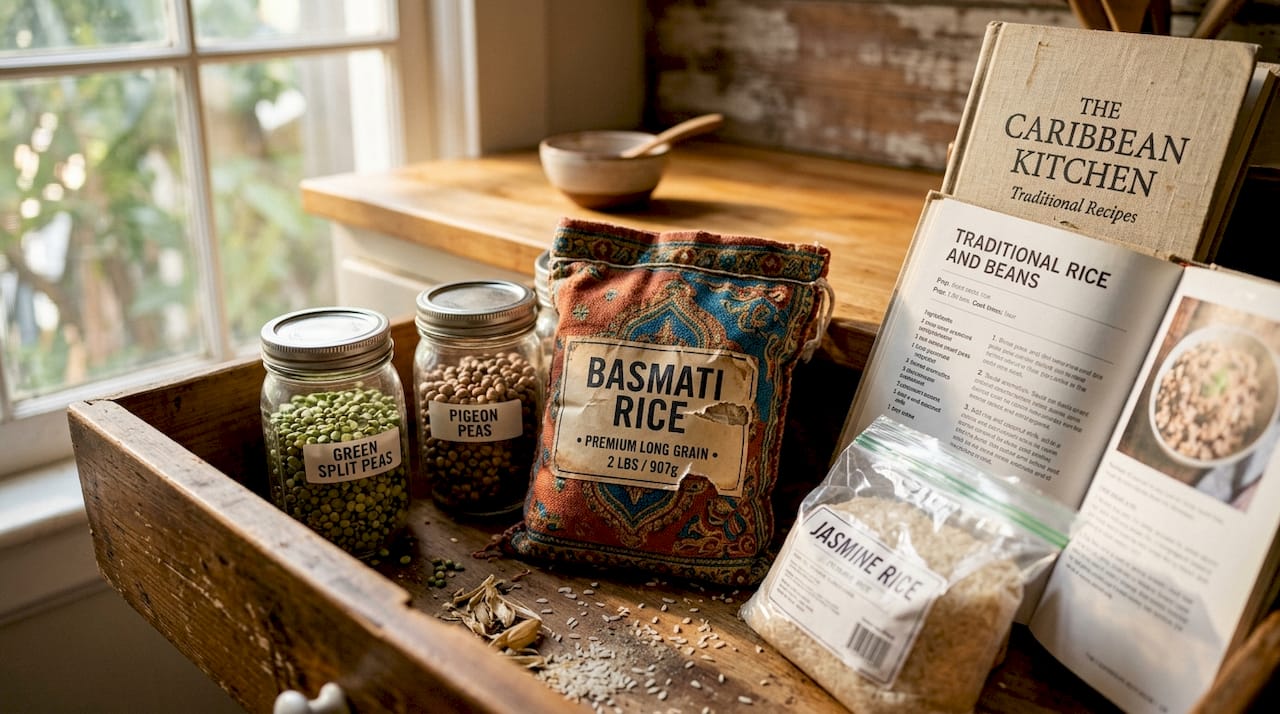
Legumes carry far more flavor responsibility than most cooks realize. Split peas thicken callaloo and dal. Black-eyed peas anchor Hoppin’ John and Trini-style stews. Pigeon peas (also called gungo peas) are essential for Jamaican rice and peas. Check out seasonal Caribbean staples for timing your purchases when these are most affordable.
| Staple | Primary use | Storage life (airtight) |
|---|---|---|
| Long-grain white rice | Pelau, rice and peas | 2 years |
| Split peas | Dal, callaloo, soup | 1 to 2 years |
| Black-eyed peas | Stews, accra fritters | 1 to 2 years |
| Pigeon peas | Rice and peas | 1 year (dried) |
| All-purpose flour | Fried bakes, roti, dumplings | 6 to 12 months |
| Cornmeal | Cou cou, porridge, dumplings | 1 year |
Roots and ground provisions deserve their own mention. Cassava, yam, dasheen, and eddoes add earthy body to soups and stews that no grain can replicate. Fresh ground provisions need refrigeration, but frozen versions from a Caribbean grocer are a smart pantry backup. Visit the caribbean pantry staples checklist for a breakdown of what to keep frozen versus shelf-stable.
Herbs and aromatics: building the flavor foundation
Caribbean cooking is not primarily about heat. It is about layering. And that layering starts with aromatics.
Garlic, onions, pimento peppers, and chadon beni form the holy quartet of Caribbean flavor, providing the base for nearly every savory dish. Pimento peppers (seasoning peppers) give a fruity, fragrant aroma without searing heat. They are non-negotiable for anyone who wants authentic flavor without burning their guests.
Scotch bonnet is the heat element. Use it whole in stews for subtle warmth, or burst it near the end of cooking for full fire. Never confuse it with habanero — the flavor profile is not the same, even if the heat level is similar.
Thyme is the backbone herb of almost every savory Trinidad dish. Fresh thyme beats dried for most applications, but dried thyme in an airtight jar is a reliable backup.
Aromatics and herbs balance each other in epis blends, starting with aromatics first, then layering herbs for depth. This sequencing is not optional — it is the technique that separates authentic green seasoning from a blended salsa.
Essential herbs and aromatics for your Caribbean food storage list:
- Chadon beni (culantro): Stronger than cilantro, essential for green seasoning
- Fresh thyme: Earthy backbone for stews, meats, and rice dishes
- Scallions (chives): Brightness in marinades and seasoned rice
- Garlic: Required in virtually every savory application
- Pimento peppers: Fruity aroma without burning heat
- Scotch bonnet: Measured heat with a distinctly fruity, floral note
Pro Tip: Blend chadon beni, scallions, garlic, pimento peppers, thyme, and a splash of water into green seasoning. Freeze in ice cube trays. Every cube is enough to season one pound of meat, ready in seconds. Explore more techniques at Caribbean herbs and spices and preparing Caribbean spices.
Spices and seasoning blends: flavor pillars of Caribbean cooking
Spices are where most home cooks make their biggest mistake: buying once and never replacing until the jar is empty. An empty jar of three-year-old curry powder is not a seasoning. It is colored dust.
Dry jerk rubs last 6 to 12 months in airtight jars, but freshly ground spices lose potency faster and should be replaced every 6 months. That timeline applies to your entire spice shelf, not just jerk seasoning.
Curry powder and geera (cumin) create the bold, toasty backbone of Caribbean curries. Geera is used both ground and whole, dry-roasted to release a nutty aroma before grinding. Do not skip that step.
Trinidad spice cooking emphasizes a smaller group of spices used thoughtfully alongside fresh herbs and green seasoning. More spices do not equal more flavor. The wrong spice, or a stale one, actively damages a dish.
“The difference between authentic Caribbean curry and a generic one is not the recipe. It is the quality and freshness of the spice blend in your jar right now.”
Here is a direct comparison of dry versus wet seasoning storage for your Caribbean food storage list:
| Seasoning type | Storage method | Shelf life | Best use |
|---|---|---|---|
| Dry jerk rub | Opaque airtight jar, dark shelf | 6 to 12 months | Dry rubs for grilling |
| Wet jerk marinade | Refrigerator (sealed) | 5 to 7 days | Overnight meat marinating |
| Frozen jerk marinade cubes | Freezer bags, portioned | 3 to 6 months | Batch cooking convenience |
| Ground curry powder | Airtight jar, away from heat | 6 months max | Curries, stews |
| Whole spices (geera, allspice) | Airtight jar, cool and dark | 12 to 18 months | Grind fresh as needed |
Core spices for your grocery list for Caribbean dishes:
- Curry powder (Trinidad-style or Jamaican-style)
- Geera (cumin), whole and ground
- Turmeric
- Fenugreek
- Allspice (pimento berries)
- Paprika
- Black pepper, freshly ground
- Cinnamon (for stews and desserts)
Pro Tip: Store your Caribbean spice list in a dedicated drawer away from your stove. Heat from cooking nearby is one of the fastest ways to kill spice potency. Check your storing Caribbean spices setup annually and replace anything past its prime before it costs you a ruined pot.
Comparing pantry essentials: how to blend and use for diverse Caribbean dishes
A well-built Caribbean pantry is not a collection of independent ingredients. It is a system. Green seasoning marinates meats and seasons nearly every savory Trinidad dish, functioning as both a wet marinade and a cooking base. Your dry spice blends then layer on top of that aromatic foundation.
Green seasoning, spices, and herbs together create the bold, memorable flavors that make Caribbean food immediately recognizable. The sequencing matters: aromatics first (garlic, onion), then wet herbs (green seasoning), then dry spices added mid-cook for toasting.
| Dish | Green seasoning | Key dry spices | Finishing herb |
|---|---|---|---|
| Curry goat | Yes, overnight marinade | Curry powder, geera | Fresh thyme |
| Pelau | Yes, chicken marinade | Black pepper, paprika | Scallions |
| Callaloo | Minimal | None typically | Chadon beni |
| Jerk chicken | Optional base | Full jerk rub | Scotch bonnet |
| Curry channa | No | Curry powder, geera, turmeric | Culantro |
Practical layering principles for home cooks:
- Start every dish with aromatics sautéed in oil: garlic, onion, pimento pepper
- Add green seasoning after aromatics soften, letting it cook down for 2 to 3 minutes
- Toast dry spices briefly in the pan before adding liquid
- Finish with fresh herbs after heat is off to preserve brightness
This system applies whether you are following Caribbean meal prep tips or working through master Caribbean recipes from scratch.
The overlooked essentials and insider tips for your Caribbean pantry
Here is what most Caribbean pantry guides skip: the maintenance habits that separate a pantry that works from one that just looks stocked.
The biggest mistake home cooks make is treating dried herbs as permanent. They are not. Dried thyme that has been sitting in a cabinet for two years smells like nothing and tastes like nothing. Replacing spices every 6 months with airtight storage keeps flavor vibrant. Write the purchase date on every jar. It takes five seconds and saves you from a flat pot of curry six months later.
Fresh herbs deserve freezer space. Most Atlanta cooks cannot get to a Caribbean market weekly. Chadon beni, thyme, and scallions can all be frozen. Blended into green seasoning and frozen in cubes, they deliver fresh flavor on any weekday with zero prep time.
Proper seasoning storage protects delicate flavor compounds against four enemies: light, heat, moisture, and oxygen. Opaque jars beat clear glass. A cool cabinet beats a shelf next to the stove. Silica gel packets inside spice storage containers extend shelf life without affecting flavor.
Salt and black pepper are so basic they get ignored. That is a mistake. Proper Caribbean ingredient storage applies to everything, including salt, which can clump in humidity. Freshly cracked black pepper makes a measurable flavor difference in simple dishes like stewed chicken. Do not take the basics for granted. Use the spice preparation guide to develop a consistent prep and refresh routine for your whole pantry.
Where to shop for authentic Caribbean pantry staples in Atlanta
Atlanta has a real Caribbean food community, and knowing where to shop matters as much as knowing what to buy.

For home cooks who want convenience without sacrificing authenticity, the TOJ Express online store carries a wide selection of trusted Caribbean staples and spices, shipped directly to your door. No driving across town. No substitutions. Just the real thing. You can also get smart about shopping Caribbean groceries in Atlanta with local tips for finding fresh herbs and specialty produce at Caribbean-owned markets. For pantry flexibility, stocking up on Caribbean frozen food essentials gives you ground provisions, seasoning peppers, and even prepared bases ready when fresh is not available. A well-planned pantry starts with knowing your sources.
Frequently asked questions
What are the must-have grains for a Caribbean pantry?
Rice, split peas, lentils, and black-eyed peas are the core grains and legumes you need. Stocking these 5 to 7 staples stretches your meals and covers most one-pot Caribbean dishes.
How should I store Caribbean spices to keep them fresh?
Keep spices in airtight, opaque containers away from heat and moisture. Opaque airtight jars with minimal oxygen exposure preserve dry rubs and spice blends for 6 to 12 months.
What is green seasoning and why is it important?
Green seasoning is a blended mix of fresh herbs and aromatics like chadon beni, garlic, thyme, and scallions. It marinates meats and seasons nearly every savory Caribbean dish, functioning as both a base and a finishing flavor.
How often should I replace ground spices in my pantry?
Replace ground spices every six months. Freshly ground spices fade faster than whole spices, and stale powder actively dulls your food rather than just offering less flavor.
Can I freeze homemade green seasoning or jerk marinades?
Absolutely. Freeze both in ice cube trays for portioned, ready-to-use servings. Freezing seasoning portions maintains quality and flavor for several months, making weeknight Caribbean cooking genuinely fast.